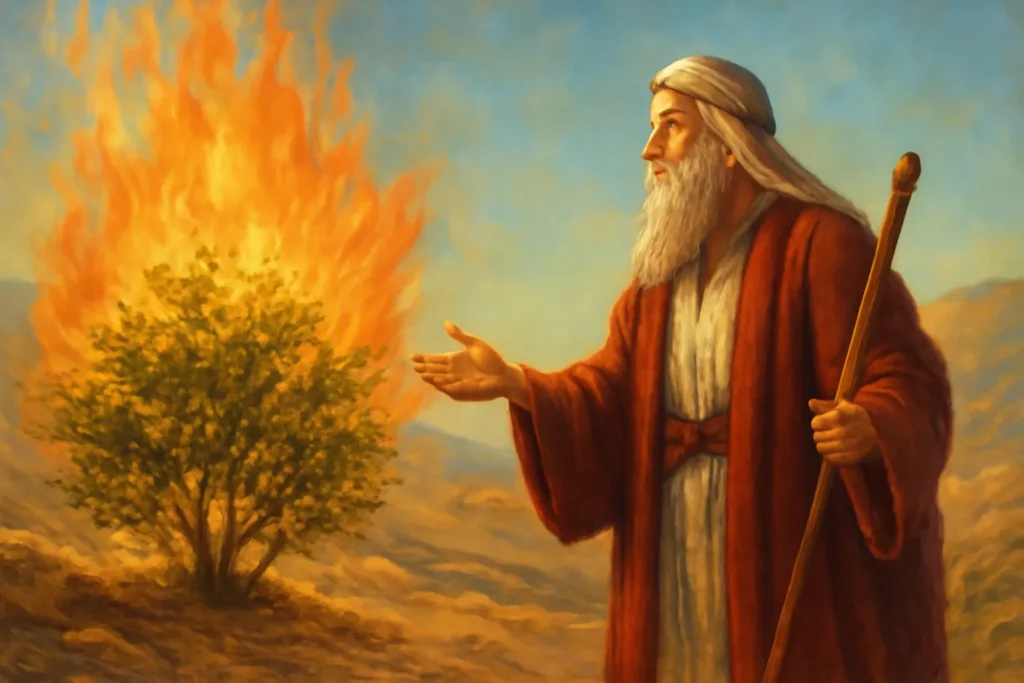
Among the dramatic episodes of the Hebrew Bible, few scenes are as enduring or as theologically provocative as the moment when a burning bush ignites in the desert and speaks. This is not merely a story about a miracle in a remote corner of the world; it is a foundational theophany—the manifestation of the divine presence in a way that is comprehensible to human beings. The encounter between Moses and God at the burning bush sets in motion the deliverance of a people, the revelation of a divine name, and a blueprint for how God engages with leadership, mission, and holiness. In this article, we explore the burning bush as a window into the biblical concept of theophany, the character of Moses as a leader and mediator, and the enduring significance of this encounter for faith, theology, and art.
The Setting: Midian, a Desert, and the Call Forestalled
To understand the drama of the burning bush, one must first situate it in its geographic and historical frame. Moses is described as a shepherd in the land of Midian, tending the flock of his father-in-law, Jethro. The scene unfolds on the rear-ends of the desert, near Horeb or Sinai, depending on the textual tradition. The setting is not a grand temple or a ceremonial place of worship; it is a humble, marginal location—the ordinary life of a desert shepherd. Yet in this ordinary space, the extraordinary occurs: a visitation from the divine that redefines history and reorients the life of one man and, through him, a nation.
Scholars often highlight several features of this scene that illuminate its theological purpose. The desert symbolizes emptiness and vulnerability, a place where human resources are scarce and dependence on God is singularly evident. The burning aspect—fire that consumes but does not destroy the plant—points to a presence that is powerful yet not coercive. The divine presence does not annihilate the bush or the shepherd; it transforms them, inviting cooperation rather than domination. In this way, the event dramatizes a central claim of biblical theophanies: God’s presence in the world does not erase human limits; it authorizes and equips human beings to fulfill divine purposes within those limits.
For readers across the Jewish and Christian traditions, the imagery of a burning bush invokes a paradox: vitality without destruction, holiness without annihilation, life that does not vanish under scrutiny. This paradox will recur in the divine name revealed at the heart of the encounter and in the mission entrusted to Moses. As we move deeper into the narrative, the desert encounter reveals not only God’s power but also God’s intimate responsiveness to a particular person at a particular time.
The Encounter: A Theophany in which God Speaks
The moment the burning bush becomes more than a visual marvel is when the voice of God addresses Moses directly. The text emphasizes that Moses turns aside to see this phenomenon, a gesture of curiosity and respect that signals the opening of a relationship. The narrative makes clear that the bush is not the object of worship itself; it is a vehicle through which God reveals presence and intention. The plant burning with fire is a sign that God is present, holy, and engaged with the world despite the vastness of human limitations.
As the divine voice speaks, several crucial elements emerge. First, the encounter asserts a personal, communicative God who speaks to a specific person rather than delivering a generic message to humanity. Second, God’s speech conveys purpose: God has heard the groaning of the Israelites and is ready to act through Moses. This is a theophany that blends revelation with commission—the revelation of God’s name and character becomes the basis for a mission that will reframe the destinies of a nation.
Voice, Call, and the Name of God
In the conversation, the most pivotal moment is the revelation of God’s name and identity. The deity identifies Himself with a sacred, divine name—YHWH in Hebrew—which later scholars often render as I AM or “I am who I am” in a broad sense. This naming is not a casual label but a self-disclosure: God is not a distant force or an impersonal power; He is a living, self-existent, self-defining presence who acts in the world. The snippet “I AM WHO I AM” has been the subject of extensive theological reflection, as it anchors the divine essence in timeless action and steadfast faithfulness. The name signals both immediacy and contingency: God is present with Moses now, in this very moment, and will continue to be present in the unfolding drama of liberation.
The moment also foregrounds the moral and ethical dimension of God’s character. The divine voice affirms a concern for justice—specifically, the oppression endured by the Israelites under Pharaoh—and a resolve to bring about their redemption. In this sense, the burning bush is not a mere spectacle; it is a conduit for covenantal communication, linking God’s identity with a mission that will transform history.
Holiness and Ground: The Grounded Presence
Another striking feature of this theophany is the command that accompanies the divine appearance: Moses is told to remove his sandals because the place where he stands is holy ground. The concept of holy ground emphasizes that proximity to God carries ethical, ritual, and practical implications. Holiness is not a distant category reserved for temple precincts; it infiltrates the everyday and demands a response from those whom God calls. The act of removing shoes signals both reverence and obedience, marking a boundary between ordinary space and a space where the divine enters into human affairs.
Scholars often discuss the implications of this ground as a symbol. It communicates that with revelation comes responsibility: when God chooses to reveal, God also commands; when God makes a promise, God also requests trust and action. The burning shrub thus functions as a liminal sign: it marks the threshold between the known and the unknown, between human limitation and divine possibility, between Egypt’s oppression and a liberated future.
Moses’s Response: From Hesitation to Commission
The encounter does not immediately translate into a smooth mission. Moses’s initial response is one of hesitation and self-doubt, showcasing a quintessential call narrative where a chosen instrument resists the invitation at first. The scriptures record a series of questions, objections, and concerns that reflect both human vulnerability and a steadfast divine determination to accomplish what God intends.
Who am I? Moses doubts his own authority and abilities, emphasizing his feelings of inadequacy in the face of a monumental task.
What if they ask your name? As a man who will stand before both the people and the Egyptian monarchy, Moses worries about credibility and the power of God’s name to back his claims.
Why me? The stress of leadership is real: can this ordinary man, with a history of failures and doubts, bear the burden of liberation?
What if I fail? Fear of rejection and the potential for harm to the people he leads weighs heavily on Moses’s mind.
Send someone else. A common instinct to defer to another is voiced, revealing the tension between divine initiative and human willingness.
In response to these objections, God provides reassurances, signs, and a plan for assistance. The call narrative reveals a dynamic pattern: God calls; the called person objects; God offers assurance and resources; and finally, the mission progresses, albeit with further complications. This pattern became a model for countless later call stories within the biblical tradition and enters into the broader theological conversation about vocation, leadership, and divine empowerment.
The Mission and the Signs: Power, Authority, and Assurance
The burning bush is not merely a visionary spectacle; it is a commissioning scene that includes concrete signs meant to authenticate Moses’s mission. The divine directive includes specific steps: Moses is to go to Pharaoh and demand the liberation of the Israelites. The plan, however, is not simply to declare emancipation; it is to demonstrate divine authority through demonstrable miracles. The biblical narrative soon introduces a set of public signs that will accompany Moses’s ministry and provide credibility in the eyes of the people and of the oppressors.
The God who speaks through the burning bush equips Moses with a repertoire of miracles. Among the most famous are the staff that becomes a serpent and then returns to its former shape, the plague narratives that follow, and the turning of water from the Nile into blood. These signs serve several purposes. They validate the divine call to Moses, demonstrate the reality of the God who is acting, and create a context in which the enslaved community can recognize their deliverer. In the broader biblical imagination, miracles are not self-justifying wonders but means of communication—messages that reveal character, intention, and covenant fidelity.
For readers in later centuries, these signs invite a broader meditation on how faith communities understand authority and power. The question is not simply “Can God perform miracles?” but “What kind of leader does God empower, and what kind of community does God intend to form?” The response in the book of Exodus emphasizes humility, obedience, and persistence in the face of resistance. Moses’s reluctant leadership is transformed by divine grace into a conduit of liberation that will reverberate across generations.
Theology of theophany: What the Burning Bush Teaches about God
In biblical terms, a theophany is a visible or perceivable manifestation of God to a human being. The burning bush is among the most iconic theophanies because it foregrounds several core theological themes:
Presence without assimilation: God’s presence does not depend on human form; the divine can appear within creation without being absorbed by it. The bush burns with divine energy but remains intact, symbolizing the mystery and sovereignty of God who acts within creation without being limited by it.
Name and self-revelation: The revelation of God’s name (YHWH) anchors identity and mission in the divine character: faithful, rescuing, and capable of delivering the oppressed.
Holiness and accessibility: The command to remove sandals underscores that proximity to God requires reverence and transformation, a theme that resonates in Jewish and Christian ethics and ritual life.
Call and vocation: Theophanies are not merely experiences; they restructure the life of the one who is called. The encounter creates a vocation that becomes a means of blessing for others.
Moses in Jewish and Christian Traditions: A Shared and Divergent Perspective
Across Jewish and Christian interpretive frameworks, the burning bush and the call of Moses have functioned as archetypal motifs. In Jewish interpretation, the call narrative is a paradigm of covenantal leadership: God chooses, equips, and sends a leader who will mediate between God and the people. In Christian tradition, Moses’s encounter with the divine is often read with a particular emphasis on the sovereignty of God, the deliverance of a people, and the foreshadowing of messianic expectations. While Christianity does not view Moses as the ultimate or final mediator, it frequently engages with the themes of vocation, grace under pressure, and the transformative potential of divine intervention in human history.
Within broader theological discussions, the burning bush also invites reflection on the nature of revelation. It shows that God speaks into time and space, uses historical situations to address present needs, and calls individuals to participate in a larger redemptive project. The figure of Moses is thus not merely a historical figure; he becomes a lens for contemplating faith, leadership, and the human response to holy calling.
The Legacy: Influence on Liturgy, Art, and Thought
The story of the burning bush has left an enduring imprint on art, music, and literature. From medieval stained glass to Renaissance paintings, from hymns to contemporary poetry, artists have drawn on the image of the bush that burns with divine life yet remains intact. Thematic threads—divine presence in unlikely places, the sanctity of action, and God’s faithfulness to a covenant—have become a source of spiritual reflection for countless communities.
In liturgical contexts, the encounter informs prayers for guidance, courage, and steadfast faith. The identification of God’s name as I AM invites believers to ground their identity in the claim that God is ever-present and ever-reliable. The call narrative also serves as a template for individual vocation: God calls people in the midst of ordinary life, equips them, and empowers them to participate in God’s rescue mission for the world.
Readers often ask how to interpret the burning bush today, or what to make of Moses’s initial resistance. Here are some concise clarifications that capture key interpretive insights:
Is the bush God? No. The bush is a manifestation through which God reveals himself. The bush itself is not the object of worship; the divine presence and speech through the bush are primary.
Why a bush that burns but is not consumed? This paradox communicates that God’s presence can be powerful and life-giving without being exhausted or controlled. It is a sign of divine energy that sustains the possibility of mission rather than a mere miracle for curiosity.
What does “holy ground” mean for today? The call to holiness remains relevant: places and moments of encounter demand reverence, ethical responsibility, and a willingness to respond to God’s initiative with obedience.
What is the significance of God’s name revealed here? The self-designation YHWH anchors a timeless claim: God is a living, acting, faithful covenant partner who is present with his people in history, not a distant abstraction.
Key Takeaways: What the Burning Bush Teaches Us
God’s presence can break into ordinary life. The desert setting and the unassuming shepherd’s life illustrate that revelations can emerge outside grand temples.
Revelation is paired with vocation. When God reveals himself, he also entrusts a mission, inviting human beings to participate in divine work.
Holiness involves transformation and obedience. Approaching the divine requires reverence (removing sandals) and readiness to respond to divine instruction.
God provides assurance and support. The objections Moses raises are met with signs, leadership, and divine partnership, illustrating that vocation is a shared enterprise between God and human agents.
Names carry identity and purpose. The revelation of YHWH binds the character of God to the mission of deliverance, underscoring the intimate link between God’s nature and his actions in history.
The Theophany’s Continued Relevance
The encounter at the burning bush remains a compelling entry point into discussions about God, revelation, and leadership for both scholars and lay readers. It demonstrates that the divine is not confined to distant concepts but is actively involved in human history, calling individuals to participate in acts of liberation, justice, and mercy. Moses’s response—initially hesitant, eventually obedient—offers a model for discerning vocations in our own time. The narrative invites believers to consider how God might be speaking to them in their own deserts, how they might respond to a holy call, and how the power of God’s presence can sustain a community through trials and triumphs alike.
In this light, the story of the burning bush is not simply an ancient event; it is a living invitation. It asks readers to attend to divine speech, to recognize the sacred in everyday places, and to commit to a course that advances liberation, justice, and covenant faithfulness. Whether read as history, theology, or literature, the Moses narrative remains a profound reminder that God’s self-disclosure in the world always carries with it a call to participate in the divine drama of redemption.




Leave a Reply