Origins of the Birth of Christ: A Journey into the Nativity
The story of the birth of Christ—often called the Nativity—sits at the crossroads of history, faith, and culture. It is not only a narrative about a single moment in time but also a catalyst for a vast set of beliefs, practices, and interpretations that have shaped civilizations for two millennia. To understand Christ’s birth is to explore how communities, from ancient Judea to modern cities, have imagined the coming of a Savior, the dawning of a new covenant, and the sign that God is with us.
Historical and literary context
Several elements come together in the account of the birth of Jesus that scholars and theologians discuss with care. First, the context of Second Temple Judaism and the longing for deliverance created a fertile ground for expectations about a Messianic figure. Then, the political backdrop—Roman rule, censuses, and a network of roads and cultural exchanges—helps explain why the Gospel writers anchor the birth in Bethlehem, the city of David, and why they frame it with prophecies that anticipate a humble origin and universal significance.
In the canonical Gospels of Matthew and Luke, the narrative emphasizes different angles of the same event. Matthew highlights the royal and prophetic fulfillment aspects, linking Jesus to David’s line and to the dreams and actions of Gentile visitors (the Magi) as signs of a universal mission. Luke, meanwhile, foregrounds social and pastoral details—the shepherds, the census, the angelic proclamation—to present the birth as a moment of divine accessibility to ordinary people and the marginalized.
Beyond the Bible, the idea of a birth that signals a new era appears across traditions. The concept of a coming Messiah who would rescue and re-create the world resonates in Jewish expectation and, in Christian interpretation, culminates in the person of Jesus. The convergence of prophecy, faith, and historical circumstance makes the origin stories of the birth of Christ a focal point for debates about history, revelation, and the character of salvation.
Key places and moments in the birth narrative
Bethlehem, the birthplace, often described as fulfilling the Micah prophecy about a ruler coming from Bethlehem.
The Virgin Birth, a phrase that appears in Christian tradition to describe how Jesus was conceived by the Holy Spirit in Mary, highlighting the sense that the birth defies ordinary biology and signals a unique divine action.
The Annunciation to Mary and the visitation by the angel Gabriel in some traditions, announcing that she would bear the Son of the Most High.
Guiding events such as the Magi in Matthew or the shepherds in Luke, which symbolize recognition of Jesus’ importance across social layers and cultures.
Meaning and Theological Significance of the Nativity
The appearance of the birth of Christ is not merely a dramatic story about birth; it is a theological claim about identity, purpose, and relationship with the divine. At its core, the Nativity communicates that God enters human history in a tangible, approachable way. This is often summarized in the phrase the Word made flesh, drawn from the Gospel of John, which has profoundly shaped Christian conceptions of the Incarnation.
Incarnation and the life of faith
The doctrine of the Incarnation holds that the eternal God took on human nature in the person of Jesus. In this sense, the birth of Jesus is not a purely private event but a public disclosure of God’s character, intentions, and willingness to identify with humanity in pain, joy, and need. The Nativity thus becomes a gateway for contemplating questions such as: What does it mean for the divine to “dwell with us”? How does divine sovereignty intersect with humility and vulnerability?
Many theologians describe the Nativity as a paradox: the infinite God entering a finite life, the powerful acting through weakness, and the Creator humbling to dwell among creatures. This is why Christian tradition often highlights themes of humility, accessibility, and mercy in connection with the birth story. The event signals that salvation comes not through force or splendor but through a precisely calculable choice of grace laid within human vulnerability.
Prophecy, fulfillment, and the long arc of salvation history
For believers, the birth narrative is a fulfillment of centuries of prophecy. The lines from Hebrew scriptures—about a coming Messiah who will shepherd God’s people and reign in justice—are interpreted in light of the birth of Christ. This sense of fulfillment anchors Christian faith in a broader theological arc: from covenant to fulfillment, from expectation to revelation. The Nativity becomes a turning point that redefines the meaning of kingship, power, and peace in light of the Prince of Peace’s humble birth.
Symbolism and symbolism in the Nativity narrative
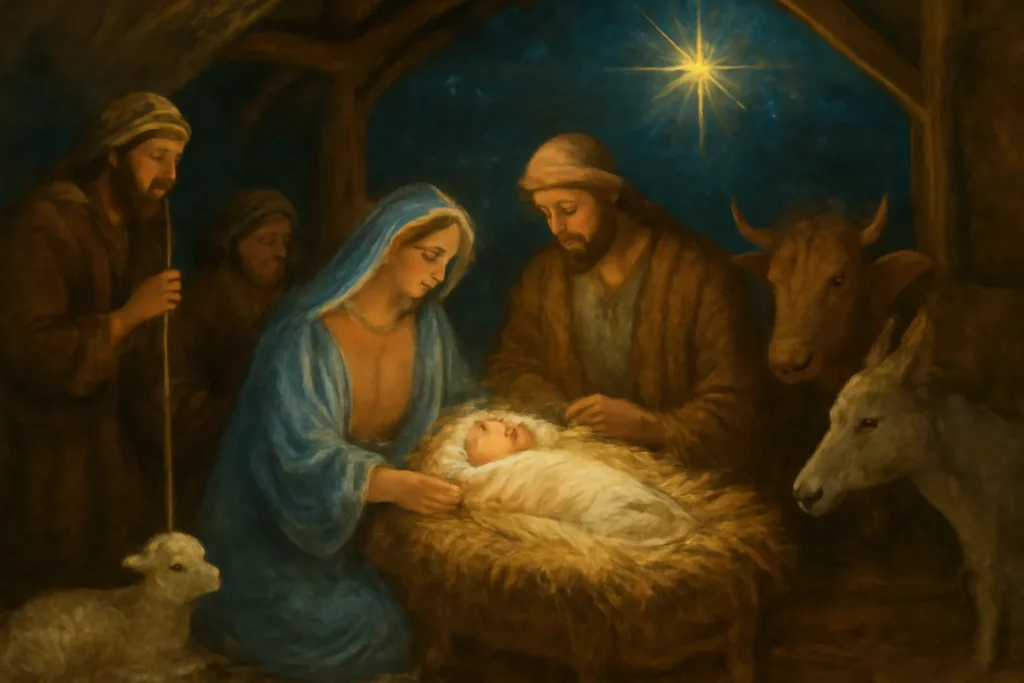
Scholars and devotional writers often note the abundance of symbols that accompany the birth of Jesus: light in darkness (nighttime shepherds, bright stars), the manger as a place of vulnerability and accessibility, animals present in the setting as witnesses to a universal event. The narrative also emphasizes continuity with the ancient story of Israel—the genealogies, the Davidic lineage, and a royal line—but recasts these elements in a way that points toward a new covenant and a universal invitation to salvation.
Christology and the personal dimension
In Christian theology, the birth of Jesus is inseparable from Christology—the study of the person and work of Christ. The Nativity anchors three important strands: divinity (the Son of God becoming flesh), humanity (the real, tangible life of a child who grows up in a family and culture), and mission (the life and teachings that follow). The birth thus has personal significance for believers: it demonstrates that God cares about ordinary life and that divine purposes intersect with an ordinary family’s story to bring about extraordinary outcomes.
Significance Across Cultures and History
Over centuries, the birth of Christ has shaped not only religious doctrine but also culture, art, music, and public life. Its influence extends beyond church walls into the rhythms of seasons, the creation of works of art, and even the shaping of ethical ideals. The Nativity has functioned as a moral and cultural touchstone—inviting people to reflect on generosity, humility, and the dignity of every human life.
Liturgical life: Advent and Christmas
The season of Advent in many Christian calendars is a time of anticipation for the birth of Christ, followed by the celebration of Christmas Day, which commemorates the same event in time. Advent emphasizes waiting, preparation, and hopeful expectation, while Christmas celebrations focus on gratitude, praise, and joy at the fulfillment of prophecy and the presence of God among us. In various traditions, the Nativity narrative is read aloud during these seasons, and communities stage dramatizations, processions, and midnight services that re-create or honor the events surrounding Jesus’ birth.
Art, music, and literature
From early Christian icons to Renaissance paintings and contemporary sculpture, the Nativity has provided a powerful subject for artistic interpretation. Composers have written carols and orchestral works that place the birth in a musical framework of wonder and awe. Poets and novelists have used the Nativity as a lens through which to explore themes of hope, humility, and the ethical implications of grace. The cultural impact of birth narratives around Christ is a testament to how a single event can ripple across centuries, shaping storytelling, public rituals, and collective memory.
Education, charity, and social ethics
Historians and theologians often point to the way Christmas season practices—charitable giving, volunteer work, and acts of hospitality—reflect a social ethic inspired by the Nativity. The humble surroundings of the manger, the emphasis on welcoming the marginalized (shepherds, foreigners, the poor), and the universal character of the event all contribute to a broader sense of responsibility toward those in need. Thus, the birth of Jesus has fueled movements of social justice, peacemaking, and humanitarian care in diverse contexts around the world.
Global receptions: varying expressions of the Nativity
Different cultures shape and express the Nativity in distinct ways. In some places, the emphasis is on solemn worship and theological reflection; in others, lively nativity plays or public celebrations accompany seasonal markets and family gatherings. The story’s adaptability—its capacity to speak to people across languages and ages—explains its enduring resonance. Whether described as the Nativity scene, the birth of Jesus, or the Christ child’s arrival, the core message remains a call to recognize light breaking into darkness and to respond with wonder and care.
Different Perspectives on the Birth of Christ
Across Christian traditions, the birth of Christ is understood through various emphases. Although there is broad agreement about the overall importance of the Nativity, doctrinal nuances shape how believers interpret specific details and their implications for life today.
Catholic and Orthodox emphases
In Catholic tradition, the Virgin Birth is often highlighted as a sign of the miraculous nature of Christ’s origin, emphasizing Mary’s role as Theotokos, or God-bearer. The Nativity is connected with liturgical richness, including feasts, icons, and devotional practices. Among the Orthodox, the Nativity is celebrated with a strong focus on the Incarnation and the mystery of God becoming human, with liturgies that emphasize the transcendence and immanence of God entering history in a humble manger.
Protestant perspectives
Many Protestant communities place significant attention on the historical reliability of the Gospel accounts, the theological significance of the Incarnation, and the universal scope of salvation announced at the birth. Some emphasize the human aspects of the story—the hometown context, the journey, the family life of Mary and Joseph—as doors to reflect on everyday faithfulness. Others highlight the moral and ethical implications of the Nativity, such as hospitality to strangers and care for the vulnerable, as essential features of Christian discipleship tied to the birth narrative.
Scholarly and critical approaches
Modern scholarship often treats the Nativity narratives as two distinct portraits—Matthew’s and Luke’s—that share some common motifs but diverge in details and audience. Critics discuss sources, dating, and historical plausibility, while pastors and lay readers often focus on the spiritual meaning and the ways the stories invite trust in God’s purposes. The conversation between faith and reason, history and devotion, continues to add depth to how Christians understand the birth of Christ and its implications for interpretation and practice.
Modern Relevance and Debates About the Nativity
In the contemporary world, the narrative of birth of Jesus remains both a source of inspiration and a topic of debate. Contemporary readers wrestle with questions about historicity, symbolism, and the ways in which an ancient story can illuminate modern life. The Nativity’s enduring power lies in its capacity to speak to every generation about hope, identity, and the possibility of transformation.
Historic questions and faith-based answers
What is the historic reliability of the narratives in Matthew and Luke?
How do we understand the Virgin Birth within the framework of science, history, and theology?
What do the Gospels mean by presenting Jesus as the Messiah and the Emmanuel—“God with us”—in the context of ancient expectations?
Ethical and social reflections
Many readers find in the Nativity a call to humility, generosity, and solidarity. The humble circumstances surrounding Jesus’ birth encourage viewers to see worth in the lowly and to extend hospitality to those who are marginalized. In a world of social stratification and abundance, the story invites a reexamination of wealth, power, and purpose. It also inspires commitments to protect human dignity, support families in distress, and promote peace where there is conflict.
Contemporary expressions and cultural vitality
Today, the birth of Christ continues to appear in films, literature, music, and public rituals. From family Christmas traditions to global humanitarian initiatives, the Nativity contributes to a shared vocabulary for discussing hope and renewal. In civic life, the celebration of Christmas—whether celebrated in churches, schools, or city squares—often becomes a moment for communities to gather, reflect, and extend care to the vulnerable through food drives, shelter programs, and neighborly acts of kindness.
In a pluralistic world, conversations about the Nativity can broaden into interfaith dialogue about the meanings of birth, divinity, and moral obligation. While the theological claims about the birth of Christ are specific to Christian faith, the themes of welcome, transformation, and hope resonate across religious traditions. Recognizing shared values can lead to constructive engagement, mutual respect, and collaborative service to those in need.
Across centuries and cultures, the occurrence described as the birth of Christ has functioned as a master story in the human imagination. It is a story about beginnings—the beginning of a life regarded as divine and the beginning of a new era of human possibility in the Christian worldview. It is a story about belonging—how God comes near to ordinary people, in ordinary places, and invites a response of faith, gratitude, and action. It is a story about hope—how darkness can be pierced by a light that has the power to heal wounds, reconcile differences, and bind communities in shared purpose.
For readers today, engaging with the Nativity involves both honoring the origins of the birth narratives and exploring their implications for contemporary life. From the historical-critical questions about how the stories were formed to the devotional practice of celebrating God’s faithfulness in history, the event remains a living invitation to contemplation and action. Whether you approach birth Christ as a theological mystery, a historical narrative, or a personal encounter with grace, its enduring significance lies in its ability to prompt wonder, responsibility, and a renewed sense of purpose in the life of faith.
In short, the birth of Jesus—often called the Nativity or the Nativity Story—allows people to ask: what kind of world do we want to inhabit? How shall we respond when light enters our lives in surprising and vulnerable ways? By examining its origins, meaning, and significance, readers can gain a richer understanding of a foundational event that has shaped art, culture, and belief for generations—and that continues to challenge and comfort those who seek hope in a changing world.
Key takeaways
The Nativity presents the Incarnation as a central truth of Christian faith: God becoming human in the person of Jesus.
The origins connect historical realities, prophetic expectations, and theological claims about salvation and mercy.
The meaning of Christ’s birth centers on humility, accessibility, and the establishment of a new kind of kingship rooted in service and peace.
Across cultures, the birth narrative has inspired art, music, rituals, and acts of compassion that continue to shape society.
Contemporary discussions about historicity and interpretation coexist with enduring devotional practices that invite faith, reflection, and ethical action.
Ultimately, whether you call it the birth of Christ, Christ’s birth, or the Nativity, the story remains a powerful invitation: to recognize the divine in the ordinary, to welcome the vulnerable, and to commit to a life that seeks peace, justice, and mercy for all people.








Leave a Reply