Bible donkey speaks is a striking biblical episode that centers on the talking donkey of Balaam and the divine interruption that reveals deeper truths about perception, obedience, and power. This article explores the story as it appears in the Book of Numbers, often titled “Balaam and the Talking Ass” in traditional retellings, and then widens the lens to consider its literary, theological, and devotional significance. Whether you call it a speaking donkey, a talking donkey, or a donkey with a voice, the moment when the animal speaks becomes a hinge on which the narrative turns from human initiative to divine direction.
Context: Who was Balaam and what is the setting of Numbers 22?
The narrative of Balaam the prophet sits in a tense moment of Israel’s journey toward the Promised Land. Balaam is approached by Balak, king of Moab, who fears the Israelites encamped along his border. If Balaam prophesies blessing Israel rather than cursing it, Balak hopes to derail the people’s advance. The encounter raises a foundational question: who holds the real power—human ambition or divine sovereignty?
To understand the donkey speaking moment, it helps to map the characters and the setting. The cast includes:
Balaam — a prophet whose reputation travels beyond his own community. He is consulted for his reputed insights and foretold outcomes.
Balak — the king of Moab who seeks to thwart Israel’s progress and finances the expedition to hire Balaam as a weapon of curse.
The angel of the Lord — a divine messenger who stands in the way with a drawn sword, unseen by Balaam until the moment of revelation.
The donkey — Balaam’s loyal beast, who becomes the instrument through which divine truth is delivered in a startling, humanly accessible way.
Key terms tied to this story include the concept of divine providence, the tension between human agency and God’s instruction, and the use of animal imagery to convey prophetic rebuke. In many Christian and Jewish readings, the donkey’s speech is not merely a novelty; it is a dramatic device that arrests Balaam’s biased expectations and forces him to confront a moral and theological reality beyond his own plans.
For readers and students of the Bible, the episode serves as a case study in how a narrative uses a seemingly comic or improbable turn to press a serious point: God’s purposes prevail, and human perception can be clouded by ambition or fear. The donkey becomes a conduit for truth that Balaam cannot ignore, even as he attempts to press forward on a path that divine instruction has not sanctioned.
The moment the donkey speaks: what the text actually says
The core event unfolds in Numbers 22. The narrative tension mounts as Balaam saddles his animal to go with Balak’s men. The donkey has already become a symbol of fidelity and restraint—refusing to move when the road is blocked by an angel’s sword. It is precisely at this juncture that the miraculous voice enters the scene.
The basic sequence can be summarized as follows:
The angel of the Lord blocks the path with a sword drawn, unseen by Balaam at first.
The donkey perceives the danger and tries to avoid the obstacle, veering off the road into a field, then pressing against a wall, and finally crushing Balaam’s leg against a wall when the animal is forced back onto the path.
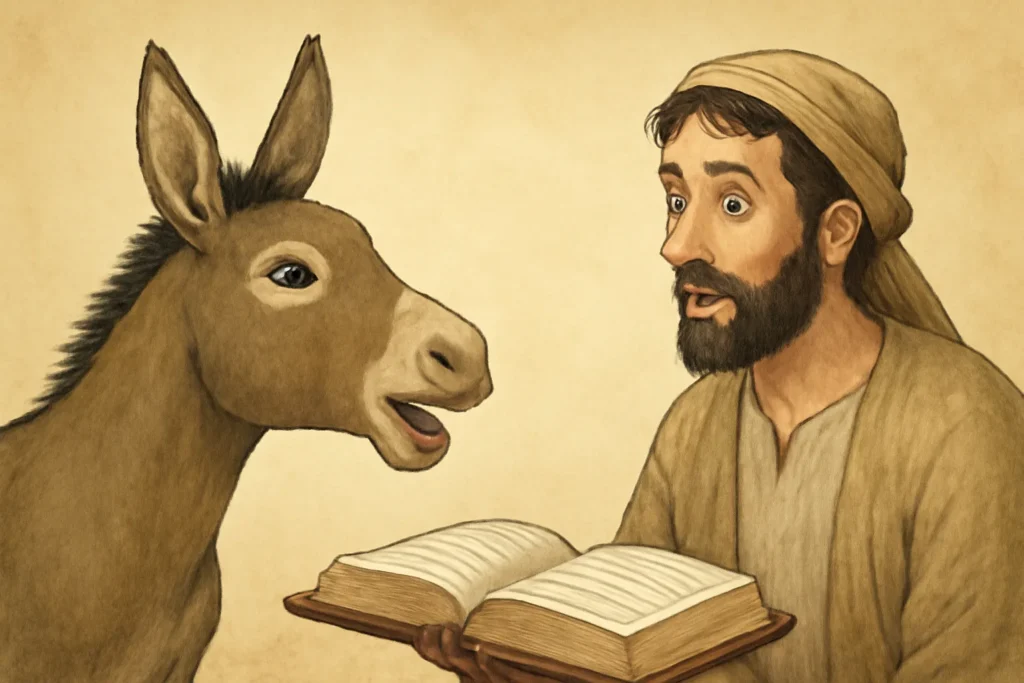
After Balaam beats the donkey three times, the LORD opens the donkey’s mouth and she speaks in human language to address Balaam directly.
The donkey’s question—“Why have you beaten me these three times? Have I not been your donkey on which you have ridden, ever since I was yours?”
The donkey’s rebuke — a remarkable moment in which the animal’s voice communicates with reason and moral clarity.
The divine revelation — after the donkey speaks, the LORD opens Balaam’s eyes so that he can behold the angel and receive a direct command about how to proceed.
Within this framework, several lines from the KJV edition capture the moment’s cadence, offering a bridge between narrative drama and theological insight. For instance, the donkey’s line to Balaam is direct and practical: “Am not I thine donkey, upon which thou hast ridden, ever since I was thine unto this day? Was I ever wont to do so unto thee?” (Numbers 22:30). The most famous pronouncement, however, is the scriptural pivot: “And the LORD opened the mouth of the ass, and she said unto Balaam, What have I done unto thee, that thou hast smitten me these three times?” (Numbers 22:28, KJV). In that moment, the improbable becomes the instrument of truth-telling, and Balaam’s earlier confidence begins to crack under the light of divine scrutiny.
Scholars emphasize that this episode is less about the donkey’s moral insight than about the way God intervenes in human plans. The miracle does not function as a demonstration of animal wisdom; it demonstrates God’s control over the narrative and the reliability—or unreliability—of human perception. The talking donkey is, in effect, a dramatic foil to Balaam’s human gaze, correcting his orientation toward God’s purposes rather than his own ambitions.
Some readers note the precise literary technique: the donkey’s speech serves as a dramatic pause that interrupts Balaam’s anticipated path. The speaking animal is a device right out of a larger ancient Near Eastern tradition that uses animal voices to expose human faults and to authorize divine counsel. The effect is both humorous and sobering—the donkey’s practical rebuke carries moral weight because God’s sovereignty is at stake, not merely a quirky plot twist.
Interpretive themes: divine sovereignty, perception, and the moral economy of prophecy
While the incident is often read as a single drama—the talking donkey confronting a would-be prophet—the tensions it embodies run deeper. Here are some central themes that scholars and readers routinely explore:
Divine sovereignty vs. human ambition
The episode makes a clear assertion: God’s will controls the outcome, and human plans must remain subordinate to divine intention. Balaam’s outward obedience is tested by inward motives. The angel’s admonition to Balaam—“Thou shall not go with them; thou shalt say only what I tell thee to say”—frames prophecy as a form of obedience rather than a tool for manipulation. The speaking donkey helps expose any disconnect between what Balaam intends and what God intends.
Perception and blindness
The donkey’s perceptiveness contrasts with Balaam’s spiritual blindness. The animal sees danger long before Balaam does. When the donkey speaks, it is not a mere trick of perception; it is a moral correction to Balaam’s compromised vision. The text invites readers to reflect on how easily a person can miss divine messages when guided by personal agendas or fear.
Prophetic authority and moral accountability
The episode presses the question: who has legitimate prophetic authority—the one who seeks to wield power or the one who faithfully speaks God’s word? Balaam’s later actions, including the still-present risk of language that could bless or curse, underscore a larger message about prophetic integrity. The donkey’s voice, though powerless in itself, becomes a catalyst that compels a more honest appraisal of motive and allegiance.
Animal voices as prophetic instruments
Across biblical literature, animals frequently stand as vessels for symbolic meaning. In this case, the donkey’s voice is not celebrated as animal eloquence but deployed as a vehicle for moral and theological instruction. The human reader learns to attend to the less obvious signals—the ripples of divine activity—that appear even in ordinary events (a journey, a path blocked by an unseen danger, a beating on an animal). The donkey’s speech transforms a routine travel into a moment of revelation.
Literary and theological significance: how the narrative works
Beyond the plain reading, the donkey speaking episode has served as a powerful symbol in Jewish and Christian traditions. It is often used to illustrate the following literary and theological patterns:
Humility before revelation — an animal’s voice becomes a catalyst for a humbled response from a proud human.
Judgment of false confidence — the moment exposes the limits of human scheming when confronted with divine discernment.
Redemption through correction — Balaam’s journey remains under divine control, suggesting that even misdirected motives can be redirected toward obedience when confronted by divine truth.
Intertextual resonance — the story resonates with later New Testament admonitions about greed, moral compromise, and the risks associated with false prophecy (see, for example, 2 Peter 2:16 and Jude 1:11).
Historically, the narrative has functioned as a teaching tool in both Jewish and Christian exegesis. It invites readers to consider how God works through improbable channels and how human beings are called to align their will with God’s will, even when the path is unexpected or uncomfortable. The speaking donkey thus becomes a symbol for the broader truth that God’s purposes transcend human planning, and that divine instruction is often mediated through unexpected means.
The Balaam episode is not isolated in biblical memory. It casts a shadow and a light across later writings that interpret or allude to Balaam’s story. Two key New Testament references highlight the continuing import of this narrative:
2 Peter 2:16 — The donkey’s rebuke as a rebuke of greed
The apostle Peter uses Balaam as an example of a prophet who is rebuked for wrongdoing, and he emphasizes that the moral correction came through a dumb donkey speaking with a man’s voice. This reference underscores the idea that even the lowliest creature can voice God’s truth when human arrogance would otherwise prevail. The clear takeaway is not a doctrine of animal speech but a warning about the corrupting influence of money and ambition that can distort prophetic fidelity.
Jude 1:11 — The error of Balaam as a warning against pursue wealth
In Jude, the apostolic writer Karlode and warns believers about those who have fallen into the error of Balaam—specifically, the desire for profit and personal gain. The donkey episode is part of this larger cautionary story: even those who claim prophetic status may be captivated by earthly rewards, and their paths may lead away from God’s purposes. Here the donkey’s courage to speak becomes a figure of truth-telling that, while dramatic, points to a moral truth about fidelity and integrity in leadership.
These references show how the Balaam narrative continues to function as a didactic anchor: a dramatic event that reframes later ethical exhortations about wealth, power, fidelity, and the proper relationship between human agents and divine instruction.
Practical reflections: what contemporary readers can learn
For today’s readers, the tale of the donkey that spoke offers several practical takeaways that remain relevant in both religious and secular contexts:
Beware of blindness to divine signs — just as Balaam initially fails to see the angel, modern readers can miss opportunities to discern a higher calling in ordinary situations.
Question the source of authority — prophetic or moral authority ultimately rests on fidelity to truth and obedience to higher standards, not merely on popularity or ambition.
Value humility over bravado — the donkey’s quiet presence and eventual speech remind leaders that loud confidence can conceal a lack of true understanding, whereas humility invites intervention and correction.
Use unlikely voices for truth-telling — the narrative demonstrates that insights can come from unexpected places, and it challenges readers to listen beyond conventional assumptions about “the right messenger.”
Integrate reverence with realism — the story models how reverence for divine sovereignty can coexist with a sober assessment of real-world constraints, such as political pressure and strategic risk.
In devotional settings, believers frequently reflect on how the phrase “the donkey spoke” signals that God can break through human plans, even in ordinary circumstances. Some readers use it as a reminder to pray for discernment, asking for courage to align their plans with what God is doing in their communities and in the world.
Common questions and thoughtful answers
Readers new to the Balaam narrative often have questions about the episode’s meaning, its tone, and its ethical implications. Here are some common questions and concise answers that maintain fidelity to the text while offering accessible interpretation:
Why did God allow a donkey to speak? The miracle demonstrates God’s sovereignty and serves a pedagogical purpose. It is not about the donkey’s wisdom but about God’s ability to break through human obstinacy and to deliver a corrective message through accessible means.
What does the donkey’s speech teach Balaam? It teaches Balaam to reconsider his motives and to recognize that divine instruction supersedes personal ambition. The donkey acts as a moral compass, guiding him toward obedience rather than manipulation.
Is animal speech considered normative in Scripture? Not as a general rule; the Balaam episode uses an extraordinary event to convey a theological truth. The rarity underscores the exceptional nature of prophetic revelation and divine intervention in this moment, rather than establishing a general doctrine of talking animals.
How should modern readers respond to this story? With a posture of humility and curiosity: consider how personal goals interact with divine purposes, and reflect on the ways God may communicate through unlikely channels when human perception is limited by bias or fear.
In its most enduring sense, the donkey’s voice in Numbers 22 functions as a dramatic reminder that God’s plans prevail even when human beings try to chart their own course. The speaking donkey is not only a figure of curiosity; it is a moral mirror. It invites readers to examine their own lives for places where ambition might outpace obedience, where fear could obscure perception, and where kindness (as embodied by an animal’s faithful service) may become a channel for truth-telling that wounds yet heals.
For students of the Bible, this narrative is a multi-layered teaching tool. It blends narrative artistry with theological instruction, using the speaking donkey to address issues of power, integrity, and fidelity. It invites readers to cultivate discernment, to listen for God’s voice in unusual places, and to respond with humility when confronted by divine correction. In this way, the story remains vibrant and instructive across generations—a classic example of how a single, remarkable moment can illuminate broader truths about faith, leadership, and the divine-human relationship.







Leave a Reply