The tale of a talking donkey in the Bible is one of the most striking and often surprising moments in sacred literature. It sits at the crossroads of narrative drama, theological instruction, and literary device, inviting readers to ask not only what happened, but why it matters. In this article, we explore bible donkey talking—often described as the Balaam donkey story—and unpack its context, themes, and lasting lessons. We will survey the narrative, examine its interpretive trajectories across religious traditions, and consider how the episode speaks to issues of perception, obedience, and divine sovereignty. This examination will cover the moment when a humble beast becomes a conduit for a divine message, turning a confrontation into a moral reckoning for a human prophet and for us as readers today.
The Balaam Donkey Story: Context, Characters, and What Happened
The story of a donkey speaking in Scripture unfolds in Numbers 22–24, within a larger arc about Israel’s journey through the wilderness and the complex interactions between prophetic voices, neighboring kings, and God’s purposes. The central human actor is Balaam, a non-Israelite prophet whose reputation for blessing or cursing nations makes him a figure of both possibility and peril. The opposing actor is Balak, the Moabite king who fears Israel’s advances and seeks to neutralize them through Balaam’s prophetic power. The dramatic hinge of the narrative is not Balaam’s or Balak’s rhetoric, but the moment when a donkey—an ordinary animal—refuses to move and then speaks, delivering a message that redirects the course of the story.
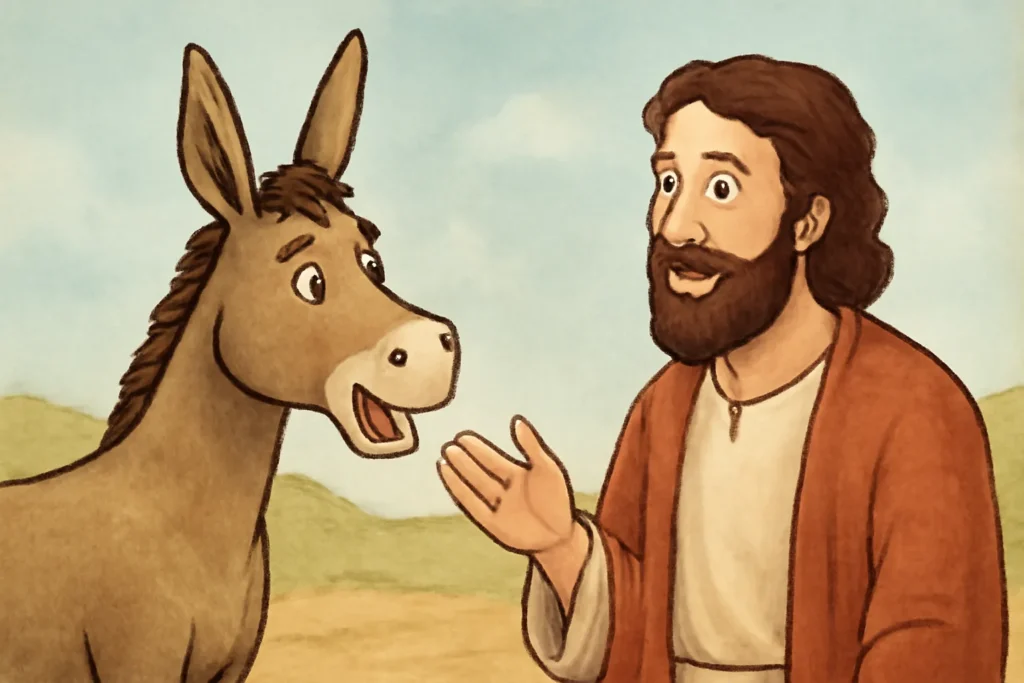
In the sequence, Balaam is summoned to come and pronounce a blessing or curse over Israel. God initially forbids Balaam from going, but Balaam persists, and a divine intervention occurs that leads to a confrontation between Balaam and a visible adversary that Balaam cannot see. The donkey’s speech interrupts Balaam’s journey, revealing an unseen danger: an angel of the Lord with a drawn sword standing in the path. The donkey, after being beaten by Balaam for failing to press forward, akhirnya speaks, saying that it has been beaten when it has saved Balaam’s life by noticing the danger before the prophet does. This moment is the turning point in Numbers: Balaam’s heart, his vision, and his motives come under divine scrutiny, and the narrative pivots toward a revelation of God’s sovereignty over human schemes.
Key figures and dynamic forces in this account deserve emphasis. The donkey is not merely a beast of burden but a dramatic instrument through which God communicates. Balaam embodies a tension between a desire for personal gain or power and a call to prophetic fidelity. Balak represents fear-driven politics that attempt to bend spiritual forces to national ends. The angel of the Lord, who stands in the path with a sword, embodies divine presence and judgment, signaling that the moral of the story concerns more than luck or rhetoric: it concerns obedience to God’s purposes even when human motives are entangled in ambition or fear. The donkey’s dialogue, in turn, becomes a vehicle for a critique of Balaam’s blindness and a corrective to his arrogance, turning the donkey talking moment into a canonical moment of grace and warning.
The Talking Donkey: Textual Details, Miraculous Language, and Literary Purpose
Miracle or Narrative Device?
At the center of the speaking donkey episode is a miracle—the phenomenon of God enabling a nonhuman creature to articulate a warning. Numbers 22:28 notes, in a concise line, that the Lord opened the donkey’s mouth to speak. Readers encounter a paradox: a miraculous disclosure in a story that is otherwise steeped in human politics and negotiation. Some scholars treat the donkey’s speech as a literal miracle, a demonstration of God’s power even in everyday life. Others interpret it as a literary device that elevates the moment’s significance, making the donkeys’ speech a surrogacy for divine communication. Either interpretation points to one thing: the narrative uses a talking animal to jolt the protagonist and the audience into a deeper level of awareness—namely, the presence of the unseen and the obligation to heed divine warnings.
The Voice as a Moral Measure
The donkey speaks with a clear admonition: Balaam has behaved as though he could ride the wind of favoritism and personal gain without regard for God’s will. The donkey rebukes Balaam, exposing his willingness to overlook danger when it suits his goals. This encounter highlights a central theme in biblical wisdom literature: the proper measure of a person is not simply their outward courage or eloquence but their alignment with divine intention. The talking donkey, therefore, functions as a moral mirror. It reveals Balaam’s moral blind spots, namely his readiness to push forward toward Balak’s agenda without considering whether such action aligns with God’s plan for Israel and for other nations. The moment insists that true prophetic power is measured by fidelity to God’s purposes, not by personal prestige or financial reward.
The language of the livestock in Numbers is restrained yet forceful. The donkey’s gentle rebuke—“What have I done to you, that you have beaten me these three times?”—is a humbling counterpoint to Balaam’s insistence. The dialogue underscores a broader theological claim: God can use unlikely means to soften a self-assured human stance and redirect a path that might otherwise lead to harm or misuse. The donkey’s speech is not merely a novelty; it is a serious theological device that invites readers to consider whose voice is authoritative—human or divine—and how divine messages reach humans when conventional channels seem obstructed by pride. The emphasis on the donkey’s audibly shared doubt and concern invites a broader reflection on discernment: how do we hear beyond the obvious cues of authority and argument to notice the moral and divine contours of a situation?
Literary and Theological Significance of the Donkey’s Speech
Prophetic Constraint and Divine Sovereignty
The Balaam episode showcases a dramatic demonstration of divine sovereignty over human agents. The narrative makes clear that prophetic power is never self-originating; it is a gift that comes with obligations. The donkey’s intervention dramatizes the limit of human perception and the necessity of divine guidance. The angel’s message, delivered through a nonhuman mouth, embodies the paradox that God can speak through any channel, if only a listening heart is present. In this sense, the donkey speaking is a reminder that prophetic perception requires humility: recognition that one can be blind to what is obvious to God and others. The story thus warns against arrogance and self-sufficiency, presenting a model for how true discernment must always be anchored in trust in God’s purposes rather than in one’s own favored readings of a situation.
Humility, Obedience, and Moral Callings
From a pastoral angle, the talking donkey narrative invites readers to consider how humility and obedience play out in moral decision-making. Balaam’s eventual consent to go to Balak is not necessarily a triumph of faith; rather, it is a test of whether his path remains aligned with God’s will after God changes His mind about Barak’s plan. The donkey’s intervention makes it clear that moral action is not simply about what one wants to do but about what God requires. This turn invites a broader meditation: when we encounter warnings, do we accept them as invitations to reorient our aims, or do we push ahead in defiance? The donkey’s speech thus becomes a catalyst for ethical reflection, encouraging readers to examine their motives, openness to correction, and willingness to alter course for the sake of righteousness.
Interpretive Traditions: How Different Faith Traditions Read the Talking Donkey
Jewish Midrash and Rabbinic Thought
In Jewish interpretive tradition, the Balaam donkey story has been read as a provocative demonstration of God’s sovereignty over the world and the limits of human foresight. Rabbinic commentaries often emphasize that God used even a modest animal to enforce moral order and to puncture human pride. The donkey’s providential warning is seen as an act of divine pedagogy, instructing readers that wisdom comes from God and that prophetic gifts require humility and caution. Some traditions view the donkey as a symbol of moral perception that transcends human prejudice, reminding readers that spiritual insight can emerge from unexpected places and channels. The text is used to discuss the nature of divine justice, the danger of greed, and the legitimacy of divine authority over human plans.
Christian Interpretive Trajectories
Across the Christian tradition, the talking donkey has been treated as evidence of God’s ongoing activity in human history and as a parable about sovereignty and obedience. Scholarly and patristic writers alike have highlighted the episode as a counterpoint to the political rhetoric of Balaam and Balak, a reminder that true blessing and judgment come from God rather than human manipulation of spiritual force. Some Church Fathers have read the donkey as an emblem of humility and as a critique of spiritual pride—an animal’s voice becomes God’s instrument to correct a proud prophet. The narrative often serves as a typology for Christ’s own role as God’s messenger who exposes human limitations and invites a deeper trust in divine will.
In Islamic tradition, Balaam himself is a figure who appears with caution in some medieval and later sources, typically framed within discussions about prophethood, divine will, and the testing of believers. The core moral remains consistent: God directs even the most unlikely agents, and human beings must heed divine warnings. The speaking donkey can be read as a cautionary emblem about arrogance and disobedience when confronted with a divine sign. While the Qur’an itself does not retell the Balaam story in the same way as Numbers, later Islamic commentators often draw on similar motifs: God’s reach extends beyond expected channels, and human arrogance can blind one to the truth that God sees all and guides all according to wisdom.
Modern Scholarly Perspectives
Contemporary biblical scholars often approach the Balaam narrative with attention to its literary design, historical setting, and rhetorical aims. Some view the episode as a deliberately provocative scene to critique mercenary prophecy and the market of influence surrounding prophecy in the ancient Near East. Others emphasize the donkey as a significant creature in a narrative about perception: the beast’s ability to see danger where Balaam cannot is an intentional contrast that foregrounds the problem of spiritual blindness in leadership. The moral lessons highlighted in modern exegesis include integrity, the limits of human agency without divine blessing, and the ethical responsibilities of those who claim to speak for God. Across this spectrum, the core message remains: God’s purposes prevail, and human plans must be oriented toward divine intention rather than personal gain or political advantage.
Lessons for Today: What the Talking Donkey Teaches Modern Readers
Humility before divine authority: Even a respected prophet can miss God’s will. The donkey’s interruption is a call to pause and reconsider one’s path.
Discernment over bravado: It is safer to seek God’s guidance than to pursue human ambition shaped by power or wealth.
God’s channels are varied: Divine messages can come through unlikely sources and unlikely circumstances; be ready to listen beyond routine channels.
Perception matters: The story invites readers to reflect on what they can see and what they cannot, and how faith can illuminate hidden realities.
Obedience over convenience: True obedience may require changing plans in light of God’s greater purposes, not just following one’s preferences.
Divine sovereignty and human responsibility: God can steer events, yet humans are responsible for their choices and motives.
Prophetic integrity: The value of a prophet lies not in money or acclaim but in fidelity to God’s instructions and to the welfare of the people.
The miraculous speech of the bible donkey talking episode is not a mere curiosity; it foregrounds a theological conviction central to biblical faith: God can reach across boundaries of species, status, and expectation to convey truth, warn of danger, or redirect action. This episode serves as a model of divine pedagogy, teaching that the divine message often arrives in ways that disrupt human schemes and moralizes. For readers, the implications are both spiritual and practical: cultivate a listening posture, seek alignment with divine will, and remain cautious about how we wield prophetic or influential power. The episode also broadens the horizon of what counts as legitimate truth-bearing source—authority is not guaranteed by status, eloquence, or expertise alone; it is proven by alignment with God’s purposes and compassion for the community’s welfare.
Throughout history, the image of a donkey speaking has appeared in sermons, catechetical writings, and art as a vivid reminder that wisdom can come from the most unexpected places. In medieval and Renaissance art, and in later devotional literature, this scene is used to illustrate moral and spiritual points: beware pride, be attentive to God’s warnings, and remember that God’s messengers do not always carry the forms we expect. In contemporary storytelling, the motif reappears in varied genres—graphic novels, drama, and film—where a seemingly ordinary character or creature breaks silence to reveal hidden motives, community danger, or a moral truth. The continuing appeal of this bible donkey talking moment lies in its capacity to shock, to invite reflection, and to reframe the problem of moral discernment in human life.
For churches, study groups, and Bible classrooms, the Balaam donkey narrative offers practical materials for teaching about moral discernment, prophetic integrity, and divine communication. It can be used to stimulate discussions on:
How to recognize and resist coercive or mercenary uses of spiritual authority.
How individuals respond to warnings that challenge preferred plans.
Ways to foster a culture of listening to God, including listening through Scripture, prayer, and community wisdom.
The ethical responsibilities of leaders who claim a prophetic voice.
The theme of grace: even in judgment-oriented moments, God’s messages are intended to guide toward life and justice.
In leadership discourse, the Balaam narrative becomes a case study in humility and accountability. Leaders often face situations where their strategic goals are tested by new information or warnings. The talking donkey reminds us that true leadership requires a readiness to change course when confronted with a higher truth. Whether one interprets the scene as a literal miracle or a powerful metaphor, the underlying message remains relevant: leadership without accountability—without listening to the broader moral or divine frame—can lead to dangerous outcomes. In this sense, the donkey’s intervention serves as an ethical pivot, inviting leaders to measure their decisions against the welfare of the vulnerable and the fidelity of their actions to the greater good.
The story of a bible donkey talking is not simply an ancient curiosity; it is a narrative with enduring relevance. It asks readers to examine how we discern truth, how we respond to warning, and how we steward power and influence in light of a larger, divine horizon. By inviting human beings to listen to an animal’s voice, the biblical text upholds a radical anthropology: wisdom can come from anywhere, and humility remains the most reliable compass in a world of competing claims and urgent demands. The Balaam narrative challenges us to consider how we might encounter God in the unexpected—whether in scripture, in a sermon, or in a quiet moment of conscience—and to respond with obedience, compassion, and fidelity to the purposes of justice and mercy that God desires for all people.
In sum, the talking donkey episode is a compact, potent lesson about perception, power, and the sovereignty of God. It invites readers to cultivate a posture of listening—remembering that divine guidance often arrives in surprising forms—and to act with integrity even when such guidance runs counter to personal plans or public acclaim. As readers today, we can draw from this ancient narrative the ongoing call to seek truth, to honor God’s purposes above our own ambitions, and to recognize that voices of warning can come from the most unlikely sources, including a humble donkey that, in that moment, spoke a truth too vital to ignore.








Leave a Reply