Boaz and Ruth Love Story: A Biblical Romance of Loyalty
The tale often described as the Boaz and Ruth love story is more than a charming romance set in ancient Bethlehem. It is a narrative woven from threads of faith, loyalty, hospitality, and providence. The pairing of Ruth, a Moabite widow who chooses to embrace Naomi’s God, with Boaz, a generous and righteous landowner, unfolds within a cultural framework that prized family obligation, gleaning labor, and the integrity of the goel—often translated as the kinsman-redeemer. Read as a whole, the Boaz–Ruth saga illuminates how personal devotion intersects with communal duty and how seemingly ordinary acts of kindness can have enduring consequences that ripple through generations.
Setting the stage: Bethlehem, Moab, and the harvest
To understand the Ruth and Boaz romance, one must first glimpse the world in which it unfolds. The opening chapters place us in two landscapes that shape the narrative: Moab, a land to the east, where Naomi and her daughters-in-law begin their difficult journey after famine drives them away from Judah; and Bethlehem, the hometown of Naomi’s family, where famine ends and harvest time becomes a stage for a divine storyline to unfold.
Ruth’s homeland and decision
Ruth’s choice stands at the heart of the tale. After the death of her husband, she refuses to abandon Naomi, her mother-in-law, and pledges an oath of loyalty that transcends her own country and people. In a pivotal moment, Ruth declares, “Where you go I will go, and where you lodge I will lodge. Your people shall be my people, and your God my God.” This scene—often cited as one of the most moving expressions of steadfast allegiance in biblical literature—shows a foreign woman adopting the faith and future of Naomi’s people. It also signals Ruth’s readiness to face hardship and uncertainty rather than return to her own homeland. The phrase has become a moral anchor for loyalty in love and family duty.
Boaz’s character and generosity
Across the fields of Boon-boaz-like generosity—a term sometimes used to capture the essence of Boaz’s conduct—the landowner earns respect for more than his wealth. He is portrayed as a man who honors hospitality and protects the vulnerable. When Ruth appears as a gleaner in the harvest, Boaz notices her diligence and her devotion to Naomi. He greets his workers with warmth and extends protection to Ruth, ensuring she gains access to the grain she is entitled to glean while maintaining safety and respect. In the Ruth–Boaz relationship, we see a combination of practical care and moral integrity that foreshadows a more intimate bond founded on mutual respect and shared ethical commitments.
The legal and cultural framework: loyalty, the kinsman-redeemer, and social grace
Understanding the Boaz–Ruth connection requires a grasp of the legal and social landscape. In ancient Israel, obligations to family and land were central to communal life. The concept of the goel—the kinsman-redeemer—provided a mechanism by which property and family lines could be preserved. When Naomi returns with Ruth to Bethlehem, they are widowed and economically vulnerable. The story unfolds within the boundaries of the land laws that encouraged fertility, ensured family continuity, and protected vulnerable widows and foreigners.
The kinsman-redeemer idea in brief
The goel is a male relative who has the responsibility to redeem a family member in need—whether by acquiring land or ensuring the continuation of the family line.
In the Ruth narrative, Boaz acts as a goel in the sense of providing protection, securing Ruth’s future, and restoring Naomi’s household wealth, but there is a formal step involved:another closer relative must first redeem the property before Boaz can proceed.
The process highlights a broader principle: loyalty to family and covenant obligations can be pursued with patience, integrity, and faith.
The turning point: Ruth’s bold request and Boaz’s thoughtful response
One of the most compelling aspects of the Ruth–Boaz tale is Ruth’s audacious yet respectful approach to Boaz. After Naomi’s lead, Ruth invites Boaz to become a guardian-redeemer, not through direct confrontation but through a culturally anchored, prudent request that blends courage with decorum. The narrative emphasizes the virtue of wise boldness: Ruth acts decisively but within the boundaries of social norms, seeking protection and a future for Naomi’s family line. Boaz’s response, in turn, is marked by courtesy, clarity, and a readiness to fulfill obligation without overstepping the king’s law or the moral expectations of the community.
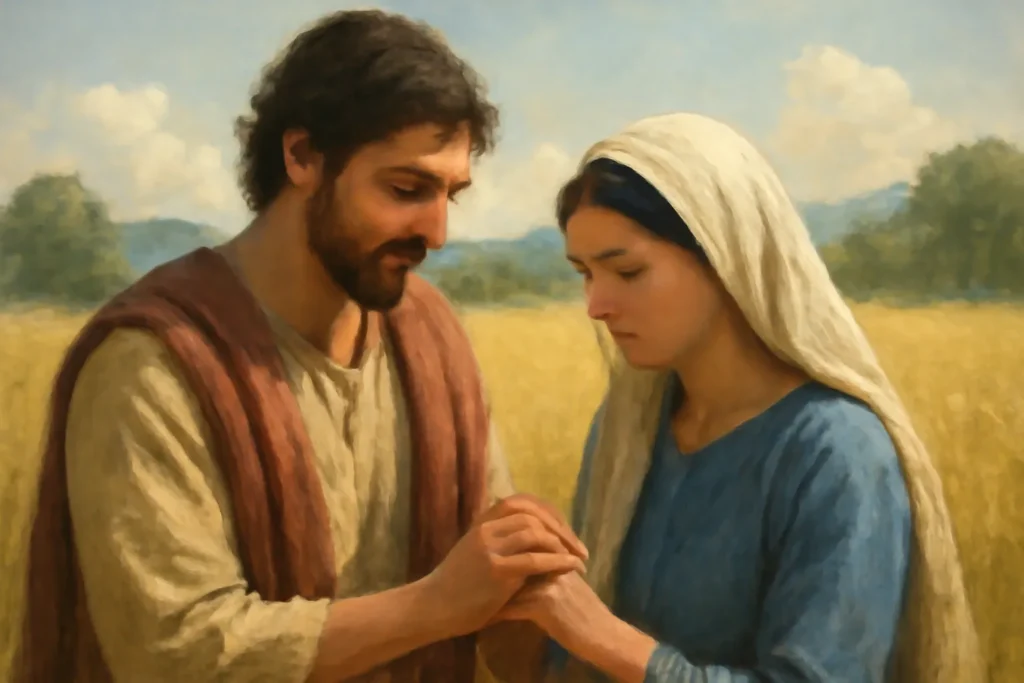
The intimate scene: a moment of respectful exchange
In the account, Ruth’s approach is framed by hospitality and humility. Boaz, recognizing Ruth’s loyalty and her role in Naomi’s life, outlines practical steps that must be taken to secure the redemption rights. The exchange demonstrates a nuanced balance: it is not a mere romance or a sudden spark of passion, but a trajectory built on trust, social legitimacy, and family responsibility. The Ruth-and-Boaz moment exemplifies how love in the biblical sense is not only about affection but also about steadfastness, moral clarity, and shared purpose.
The steps toward redemption, marriage, and a family line
The resolution of the coverage around the kinsman-redeemer exchange unfolds in a sequence that shows both legality and grace working in tandem. The closer relative initially holds the right of redemption but declines this duty, allowing Boaz to step in and claim his obligation. This part of the Boaz–Ruth saga illustrates that love often works within the constraints of communal law, but it also demonstrates how faithfulness to family and God can lead to a more meaningful union that fulfills several generations of promise.
Legal steps and ceremonial propriety
The nearer kinsman is given the opportunity to redeem, in keeping with tradition and law.
When he declines, Boaz formally agrees to redeem Ruth’s late husband’s property and to marry Ruth to continue the family lineage.
There is a public witness to the transaction—often described as a ceremonial acknowledgment before the elders at the gate—ensuring legitimacy and transparency.
The marriage, the birth, and the lineage that followed
The culmination of the tale is not merely a wedding but the birth of a son who becomes a pivotal figure in the biblical narrative. Obed—the son of Boaz and Ruth—not only fulfills Naomi’s longing for a grandson but also becomes the grandfather of King David. Thus, the Boaz–Ruth marriage is an anchor in the genealogical line that leads to one of Israel’s greatest leaders and, in Christian tradition, to the lineage through which Christians trace Jesus. This connection between a foreign widow and a devoted kinsman-redeemer reveals a broader theological motif: God’s providence at work through ordinary lives, weaving together strangers and insiders into a single, divine tapestry.
The legacy of the Ruth–Boaz saga: lineage, faith, and inclusion
Beyond the romance itself, the narrative of Ruth and Boaz carries a robust legacy for how communities understand loyalty, kinship, and grace. The story demonstrates that:
Hospitality toward foreigners can be transformed into lasting bonds and tangible blessings when rooted in integrity and generosity.
Loyalty to family and faith is not merely about personal sentiment; it translates into actions that secure the future for generations to come.
Providence often works through ordinary people who choose to do the right thing, even when it requires courage or sacrifice.
Thematic threads: loyalty, providence, and inclusion
The Boaz and Ruth love story weaves together several intersecting themes that scholars and readers frequently explore. At its core, the narrative celebrates loyalty: Ruth’s unwavering fidelity to Naomi and Boaz’s fidelity to his role as a guardian of the family line. The concept of divine providence looms large; events unfold that appear ordinary yet align with a larger purpose. Finally, the story embodies the beauty of inclusion: a Moabite woman is not only accepted but becomes a key figure in the biblical drama that anchors the dynastic line of David and, in Christian interpretation, the lineage of Christ.
Love that respects boundaries
In many retellings, the Boaz–Ruth romance is celebrated for its balance of affection and propriety. The couple’s path emphasizes that true love often begins with respect for one another’s communities, families, and obligations. The narrative does not reduce romance to sentiment alone; rather, it roots love in ethical action—protecting the vulnerable, honoring agreements, and pursuing the well-being of others as a shared goal.
Common threads: what modern readers can learn from the Ruth–Boaz tale
While the setting is ancient, the moral and relational insights of the Ruth–Boaz romance retain contemporary resonance. Several practical lessons emerge for today’s readers who seek to understand loyalty in relationships, covenantal faith, and social responsibility:
Value loyalty, even when it requires sacrificing personal comfort or security.
Practice hospitality and protection for the vulnerable, including foreigners and widows.
Honor community rules and engage in ethical decision-making that benefits the larger good.
Recognize that love can be a conduit for broader blessings—familial, social, and spiritual—across generations.
Myths, misunderstandings, and careful readings of the narrative
As with many celebrated stories, the tale of Boaz and Ruth is prone to oversimplification or romantic reinterpretation. A careful reading reveals a richer texture:
It is not merely a courtship tale; it is a study in social ethics and family responsibility.
The romance is inseparable from the legal process—kingship lineage and land ownership are integral to the narrative’s logic.
Ruth’s courageous agency is balanced by Boaz’s responsible leadership; both characters model virtue in complementary ways.
Frequently asked questions about the Boaz and Ruth narrative
Why is Ruth considered a Moabite heroine?
Ruth is celebrated for her decisive commitment to Naomi and to Naomi’s God. Her choice to stay with Naomi, adopt the Israelite people, and align with the God of Israel marks her as a model of faithfulness and courage in the face of cultural and religious differences.
What is the significance of Boaz’s role?
Boaz embodies the ideal attributes of a community leader: kindness, fairness, practical generosity, and fidelity to family obligations. His actions demonstrate that leadership in the biblical sense includes protecting the vulnerable and upholding righteous laws with mercy.
How does the narrative connect to David and Jesus?
The union of Boaz and Ruth produces Obed, who becomes the grandfather of David. From David’s line, later generations in biblical tradition trace the lineage to Jesus, highlighting the story’s enduring significance in Jewish and Christian thought alike.
the enduring message of the Boaz–Ruth love story
The Boaz and Ruth love story offers more than a romance to admire. It presents a biblical romance of loyalty that intertwines personal affection with social duty, legal order, and divine providence. Ruth’s fearless commitment to Naomi, Boaz’s steadfast generosity, and the marriage that follows together forge a lineage that becomes central to Israel’s history and to Christian theology. In a world filled with complexity, the Ruth–Boaz narrative reminds readers that true love often flourishes when rooted in responsibility, hospitality, and faith. The tale remains a timeless portrait of how ordinary lives, lived with integrity and care for others, can contribute to something larger than themselves—a legacy that endures through generations and speaks to every culture that values loyalty, kinship, and the healing power of grace.
Further reflections and recommended readings
For readers who wish to explore the Boaz–Ruth saga more deeply, several themes are especially fruitful for extended study:
Character studies of Ruth as a model of steadfast loyalty and intercultural courage.
Boaz’s leadership as a lens on social responsibility and ethical generosity.
The goel concept and how it informs understandings of family obligation in ancient Israelite law.
Connections between the Ruth narrative and the dynastic history culminating in David, and its Christian theological interpretation in relation to Jesus.
Within this rich tapestry, the Ruth–Boaz relationship stands out as a masterpiece of biblical storytelling: a testament to how loyalty, when guided by faith, yields not only immediate grace but a lasting legacy that continues to shape communities centuries later.
Glossary: key terms from the Ruth and Boaz narrative
Kinsman-redeemer (goel): A male relative who has the obligation to redeem or restore the family’s property and line.
Gleaning: The practice of collecting leftover crops after the harvest, often allowed to foreigners and widows to provide food security.
Naomi: Ruth’s mother-in-law, whose return to Bethlehem anchors the narrative’s social and economic concerns.
Obed: The son of Boaz and Ruth, through whom the Davidic line continues.
Thus, the Boaz and Ruth romance can be read as a narrative about courage, community, and faithfulness—an ancient story that nonetheless speaks to timeless questions about how we love, how we care for others, and how our choices echo through time.









Leave a Reply