The episode of Peter walking on water stands as one of the most memorable moments in the Gospels. It is frequently cited in discussions of faith under pressure, the danger of letting fear override trust, and the intimate rescue that Jesus offers to those who cry out. This article explores the biblical account, its variations across translations, its key theological themes, and the practical lessons readers today can glean from the event. By looking at the wording in different versions and the surrounding narrative, we will uncover how this miracle serves as a vivid teaching about trust, focus, and the nature of Jesus’ presence in life’s storms.
Overview: The Biblical Scene of Peter on the Water
The scene unfolds on the Sea of Galilee, after a day of ministry and miracles. Jesus had sent the disciples ahead by boat while he dismissed the crowds and prayed. In the midst of the night, a storm ballasts the boat, and the disciples struggle against the wind. It is then that Peter, in a moment of boldness or perhaps a moment of testing, asks Jesus to command him to come onto the water. The response is a direct invitation: “Come”. Peter steps out of the boat and begins walking toward Jesus, defying ordinary physics as he moves across the surface of the sea. The narrative emphasizes both the possibility of faith when anchored in Christ and the danger of fear when the eye shifts away from the Lord to the surrounding circumstances.
This account appears most fully in the Gospel of Matthew, with a parallel, briefer reference in Mark that emphasizes Jesus’ intervention and the disciples’ awe. The event is often taught as a two-movement lesson: first, the glad confidence that comes from hearing Jesus’ call, and second, the abrupt disruption of that confidence when earthly fears intrude. The real miracle, many scholars note, is not merely Peter’s physical feat, but the demonstration of trust in the face of danger and the gentle but pointed correction that follows when doubt arises.
Where It Appears in the Gospels
Matthew’s Detailed Account
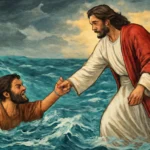
In Matthew’s telling, the narrative centers on Peter’s courageous invitation and the subsequent display of faith. The text records the sequence clearly: after Jesus invites, Peter steps out of the boat and begins to walk on the water toward Jesus. The miracle is framed by a warning against overconfidence and a reminder of the necessity of keeping one’s eyes on Christ. The moment of doubt is sharply defined: “when he saw the wind boisterous, he was afraid, and beginning to sink, he cried, saying, Lord, save me.” The rescue is swift: “Jesus stretched forth his hand, and caught him.” and the rebuke follows: “O thou of little faith, wherefore didst thou doubt?” The scene ends with awe among the other disciples and a reaffirmation of Jesus’ authority over nature.
In the King James Version, the wording emphasizes the dramatic contrast between Peter’s initial boldness and his later fear: “And when Peter was come down out of the ship, he walked on the water, to go to Jesus.” The very act of stepping onto the water is highlighted as a demonstration of trust, while the subsequent sinking underscores that faith must be anchored in Christ, not in outward circumstances.
Mark’s Brief but Theologically Rich Mention
The Gospel of Mark presents a briefer but potent pointer to the event. While Mark 6 includes the episode of Jesus walking on the sea and the disciples’ fear of a ghost, the emphasis shifts toward Jesus’ recognition of the disciples’ distress and his command to take heart. In Mark’s account, the scene may foreground Christ’s presence among the storm-tossed waters and the disciples’ growing awe as they witness his mastery over the elements. Although Peter’s bold step is not described in as much detail as in Matthew, the passage invites readers to consider what it means to hear the Lord’s call and to respond with faith—even when the wind and waves roar.
Theological Significance: What the Episode Teaches About Faith
The Peter-on-water narrative functions on several levels—historical, spiritual, and practical. Across Christian traditions, readers draw from it a constellation of themes that illuminate faith in ordinary life and in moments of crisis.
Faith as a response to a call: The decisive moment comes when Jesus says, “Come”. Peter’s faith begins not with certainty but with obedience to the Word of Christ. The invitation itself is powerful because it precedes any proof of success or safety.
Trust versus sight: Peter’s experience shifts from confidence when he keeps his gaze on Jesus to fear when he turns his attention to the wind and waves. The contrast invites readers to consider how attention to Jesus can shape behavior under pressure.
Divine intervention in human weakness: The immediate rescue—“Jesus stretched forth his hand”—shows that God’s mercy meets human frailty. The miracle is not only Christ’s power over natural forces but his readiness to uphold those who falter.
Rebuking doubt with gentle correction: The phrase “O thou of little faith, wherefore didst thou doubt?” is not a scolding for mere error, but an invitation to deepen trust. The correction is followed by reassurance and continued accompaniment with the disciples.
Contextualized in a larger narrative arc: This event sits amid Jesus’ ministry in Galilee, the response of the crowds, and the disciples’ evolving understanding of who Jesus is. It foreshadows later revelations of Jesus’ divine authority and the call to wholehearted discipleship.
Across different translations, these theological threads remain, even when the language varies. The core message that faith involves trustworthy listening to Jesus, and that Christ is present in the storms, remains consistent whether one reads in the King James Version, the New International Version, the English Standard Version, or another widely used translation.
Linguistic Variations: Phrasing the Miracle Across Translations
To gain semantic breadth, it helps to compare how various translations phrase the event and its key moments. Here are representative renditions and paraphrases that illustrate the breadth of wording while preserving the core facts:
“And he said unto them, Come.” – The direct invitation that initiates the miracle, echoed across translations, often placed near Peter’s bold action.
“And when Peter was come down out of the ship, he walked on the water, to go to Jesus.” – A classic phrasing from the KJV that foregrounds the miraculous walking itself.
“But when he saw the wind, he was afraid; and beginning to sink, he cried, saying, Lord, save me.” – A vivid depiction of fear arising from external circumstances.
“And immediately Jesus stretched forth his hand, and caught him.” – The swift rescue that punctuates the moment of faltering faith.
“O thou of little faith, wherefore didst thou doubt?” – A restrained rebuke that invites reflection rather than condemnation.
“He walked on the sea” vs. “he walked on the water” – Subtle wording differences that highlight either the surface property of water or the nature of the sea as a vast, moving domain.
“Come, Peter” vs. “Come” – Some translations explicitly name Peter as the one responding to Jesus’ invitation, adding a personal dimension to the call.
Paraphrases and fresh translations also attempt to capture the emotional texture of the moment—urging readers to feel the tension between risk and trust, between human frailty and divine invitation. Some contemporary paraphrases may emphasize the inner dialogue: “Peter steps out in bold faith, yet doubt creeps in as the wind rises.” Others stress the communal dimension: the other disciples witnessing Peter’s attempt and the surrounding awe as Jesus reveals himself in the storm.
Notes on Contextual Language
The phraseology in each version can influence interpretation. For example, “walked on the water” versus “walked on the sea” might evoke different imagery: water as a boundary to cross, or sea as a vast, unpredictable realm. Readers should consider how the surrounding verses, historical culture, and even the era of translation shape the emphasis of the narrative. Regardless of wording, the central message tends to focus on the miraculous trust of Peter and the gracious rescue that followed.
Historical and Cultural Context: What Was the Sea of Galilee Like?
The Sea of Galilee sits in a region where fishing was a common livelihood and boats of the era were essential instruments for travel and work. The weather can shift quickly, with winds that create sudden swells on the lake. In the biblical account, the weather is not merely a backdrop; it tests the disciples and highlights the tension between human effort and divine presence. Understanding this setting helps readers appreciate why fear can arise in the midst of a storm, and why Jesus’ calm presence can be so transformative for those who cry out.
The disciples’ reaction—fear of a ghost in Mark’s account, or astonishment in Matthew’s—reflects the unfamiliarity of seeing a divine figure walk on water. The miracle thus becomes a dramatic sign of who Jesus is: not only a healer and teacher but the one who holds power over nature itself. The event, then, serves as a pedagogy about recognition: the proper response to Jesus’ call is faith that remains centered on him, even when the world around you seems dangerous or uncertain.
Practical Lessons for Modern Faith
Applying the Peter-Walking Narrative Today
The biblical story can be challenging to translate into daily life, but several actionable lessons emerge:
Respond to Jesus’ call with obedience: When Jesus says, “Come”, faith begins with obedience to his invitation, even if the path ahead is unclear. The first step is trusting the Caller, not predicting the outcome.
Keep your focus on Christ in the midst of storms: The moment Peter’s attention shifts to the wind, doubt surfaces. In modern life, the storms can be anxiety, failure, criticism, or uncertainty about the future. Keeping eyes on Jesus, through prayer, Scripture, or communal support, can sustain us in difficult times.
Acknowledge fear without letting it define action: Fear is natural, but it does not have to be the final word. Peter’s cry for help is a model for honest, vulnerable prayer—calling out to Jesus while still seeking his help.
Accept the immediacy of divine rescue: The text emphasizes that Jesus “immediately” reached out to Peter. Readers can trust that God’s response to human weakness is prompt and personal, not distant or theoretical.
Reflect on the role of community: The storm scene involves not just Peter but the entire company in the boat. The broader message includes encouragement from believers and the shared witness of faith—even when one individual falters.
Different readers may find additional applications depending on their life situation. Some may see a call to take a risk for a mission or for service in challenging environments. Others may see a meditation on spiritual disciplines that keep faith alive when doubt is tempting. The richness of the narrative lies in its ability to speak to various contexts without losing its core message about trust, presence, and rescue.
Like many powerful biblical episodes, the Peter-walking story has been interpreted in ways that need careful nuance. Here are some common misunderstandings and clarifying notes:
Misunderstanding: Walking on water is a model for all Christians to do literal miracles. Clarification: The text emphasizes Peter’s faith in Christ, not the universal ability to perform miracles in every situation. The emphasis is on trust in Jesus, not on natural prowess.
Misunderstanding: Peter never doubted if Jesus would help him. Clarification: The narrative highlights a moment of doubt that begins to surface as Peter notices the wind. This doubt is real and relatable, which makes the rescue all the more poignant.
Misunderstanding: The wind is a minor detail. Clarification: The wind is part of the setting that triggers the moment of fear and shows how natural forces test human trust. It also points to the power and sovereignty of Christ over creation.
Reading with attention to context—historical, literary, and theological—helps prevent misreadings that overemphasize the miracle as a standalone stunt or underemphasize the call to faithful response.
The narrative is rich in symbolic resonance. Water, often representing life-sustaining force, becomes the stage for a test of faith. Wind, a common biblical symbol for chaos or opposition, raises the stakes and heightens the sense of danger. In this scene, Jesus’ presence anchors the meaning of both water and wind—he demonstrates mastery over chaos and invites his followers to trust him even when external circumstances threaten to overwhelm them.
Water as testing ground: The sea is not just a setting; it is a proving ground for faith and dependence on God.
Wind as obstacle: The wind’s intensity functions as a real-world obstacle that tests Peter’s, and the disciples’, perception of reality under pressure.
Jesus as rescuer: The immediate response of Christ underscores the conviction that divine aid is present in moments of crisis and fear.
Faith as action, not absence of fear: The narrative implies that faith is often exercised under fear, and that action in faith can coexist with fear until help arrives.
Frequently Asked Questions
The following questions reflect common inquiries readers have about this episode. Each reflects ongoing curiosity about the text, its interpretation, and its relevance today.
Was Peter the only disciple to walk on water? The Scriptures specifically record Peter stepping out of the boat and walking toward Jesus. While the other disciples witness the event, the focus in the narrative is on Peter’s actions and his later moment of doubt.
What exactly did Jesus rebuke in Peter? In Matthew’s account, the rebuke is “O thou of little faith, wherefore didst thou doubt?” It centers on the contrast between Peter’s initial faith and his momentary fixation on the surrounding storm.
Why is this event included in the Gospel narratives? The episode serves multiple purposes: it confirms Jesus’ authority over nature, it illustrates the dynamic of faith under trial, and it invites readers into a contemplative space about calling and trust in difficult times.
How should believers respond to fear when stepping out in faith? The response can include prayer, reliance on Christ, and a sense of community that supports and reinforces trust. Jesus’ rescue demonstrates divine faithfulness even when human faith wavers.
Are there other biblical passages that echo this theme? Yes. The broader New Testament theme of trusting God in the midst of storms appears in multiple places, including Jesus calming the storm (Mark 4) and Paul’s exhortations about endurance in faith (Romans 12; Hebrews 11). These passages collectively reinforce the idea that faith involves trust in God’s presence amid life’s storms.
The Enduring Message of Peter Walking on Water
The episode of Peter walking on water is not merely a dramatic miracle; it is a compact teaching about the rhythm of faith under pressure. The invitation that begins the moment—“Come”—remains a template for readers today: when Jesus calls, stepping out in trust can produce remarkable, if fleeting, displays of faith. But the narrative also keeps a sobering mirror before us: fear can distract, distractions can endanger, and yet Jesus is near to rescue and restore. The tale culminates not in Peter’s outward success, but in Christ’s gracious intervention and the growth of the disciples’ recognition of who Jesus is.
For modern readers, the value lies in the invitation to reflect on how we respond to Jesus’ calls in our own storms. Do we fix our gaze on him, or do we become preoccupied with the waves? Do we cry out for help when we begin to sink, trusting that Jesus will extend a hand? And do we recognize, with the witnessing disciples, that the true measure of his power and presence becomes clear in moments when the natural world cannot explain or control what happens next?
In the larger arc of biblical narrative, Peter’s experience invites a ongoing journey: to grow in faith, to learn to cooperate with Christ’s work even as fear arises, and to trust that, in the storms of life, the Savior is present, calling, rescuing, and guiding toward a deeper, more resilient faith.









Leave a Reply