The story of the bible story talking donkey is one of the most unusual and thought‑provoking episodes in Scripture. It unfolds in the Ramoth‑Gilead narrative arc of the book of Numbers, where a non‑human voice interrupts a tense encounter between a prophet, a king, and the Israelite people. This episode—often titled the episode of Balaam and the talking donkey in popular retellings—presents a drama of divine sovereignty, human limitation, and a humble beast who becomes a mirror for moral clarity. In the language of the biblical author, the ass that speaks becomes a surprising instrument through which God speaks truth to a prophet whose motives are being tested. This long article surveys the narrative, its context, its key moments, and the multiple lessons scholars and readers draw from the talking donkey in the Balaam story.
Who are the central figures in the narrative of the talking donkey?
To understand the talking donkey episode, it helps to know the principal characters and their roles in the story’s larger arc:
Balaam: A ritual specialist and diviner whose reputation for blessing or cursing nations has made him a man of interest to foreign rulers. His character in this story oscillates between cautious obedience to God and a growing concern for prestige, wealth, or political influence.
Balak: The king of Moab who seeks to thwart Israel’s advance by obtaining a divine curse upon them. Balak represents political ambition and fear, a human actor who desires control over outcome through prophetic means.
The talking donkey (the ass): A beast of burden that becomes the unlikely vehicle for divine speech. The donkey’s perceptive senses—seeing an unseen danger—stand in sharp contrast to Balaam’s spiritual blindness at critical moments.
The angel of the Lord (often described as a sword‑bearing messenger): The divine agent who blocks Balaam’s path. The angel’s presence reframes the entire incident: it is not Balaam’s power that determines the outcome, but God’s purposes that must be discerned and obeyed.
The setting and the motive: Balak, Balaam, and the wider biblical frame
This episode sits within a broader narrative about the journey of the people of Israel from the wilderness toward the promised land. Balak’s fear of Israel, and his request for Balaam’s prophetic power, dramatize a recurring biblical theme: nations under threat seek to bend divine will through human agents. The alignment between political necessity and prophetic authority is fragile, as the passage repeatedly demonstrates that human plans often collide with divine purposes. The story of Balaam’s talking donkey thus functions on at least two levels: a dramatic miracle that interrupts a path, and a theological reminder that true discernment requires obedience to God, not merely compliance with a plan that looks favorable from a political vantage point.
The journey begins: Balaam’s initial encounter with God and with human fear
The text presents Balaam as a figure who has earned a reputation for cunning in blessing or cursing, depending on who pays him. Balaam’s journey is officially sanctioned by God at first, but the narrative soon reveals a more complicated dynamic: the prophet’s ambition and the expectations of Balak press against the boundaries of divine instruction. In this context, the traveling party—Balaam, his two servants, and Balak’s messengers—moves toward a destination where a confrontation with divinely guided reality will unfold. The stage is thus set for a confrontation not only with an enemy nation but with the inner motives that drive a man who fears the loss of power more than he fears God’s guidance.
The moment of the miracle: the angel in the path and the beast’s vision
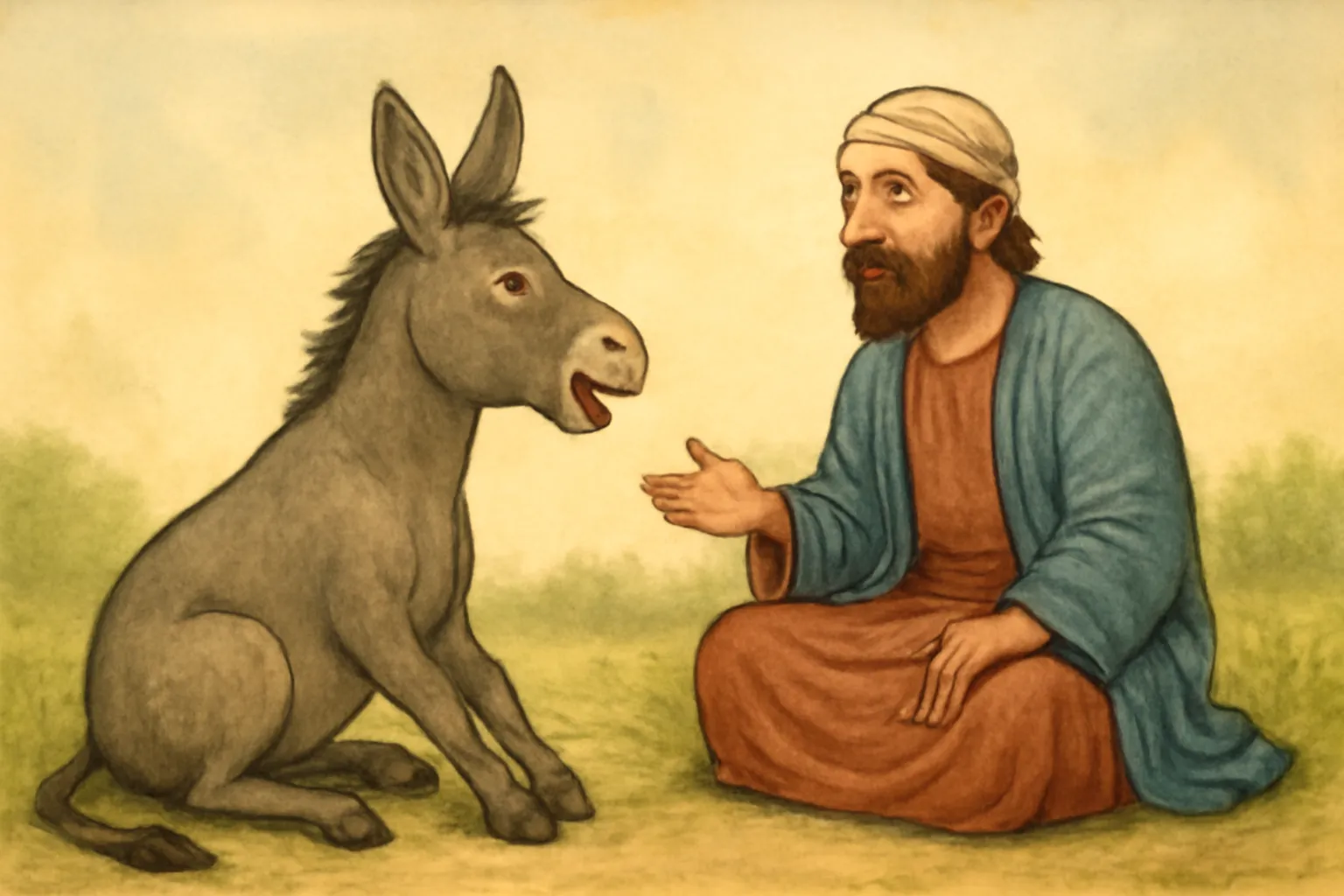
As Balaam rides his donkey along the road to perform the prophetic assignment, an angel of the Lord stands in the path with a drawn sword, unseen by Balaam but visible to the donkey. The donkey, in a scene that modern readers often describe as surreal, sees this divine obstacle and refuses to press forward. When Balaam strikes the animal to force obedience, the donkey’s resistance escalates into an in‑your‑face revelation: the animal speaks. The narrative’s cadence shifts from a routine journey to a theophany—God makes himself known through a creature who would normally be ignored or dismissed in political plots. The tension between human command and divine interruption is what makes this moment so memorable and doctrinally dense.
The donkey’s perception and Balaam’s blindness
Readers encounter a remarkable inversion: the donkey, a creature of burden and habit, becomes the one who perceives danger and acts with moral agency. The donkey’s voice—though shocking—introduces a probe into Balaam’s conscience. The episode invites readers to consider how senses of danger and moral discernment are not limited to the most powerful or the most educated. In this sense, the talking donkey serves as a counter‑foil to Balaam’s rationalizations and self‑assurance, insisting that there is a reality beyond human schemes that must be acknowledged if one would speak truly for God.
The dialogue: the talking donkey rebukes Balaam and awakens God’s message
When the donkey speaks, a dramatic turn occurs: the animal asks Balaam why he has beaten her and accuses him of treating her as if she were just a nuisance, not a partner in a divine mission. The donkey then poses a question that resonates through the ages: Have I not ridden you on all the days of your life? Have I ever done something like this before? In that moment, Balaam’s heart begins to soften, and his eyes, which had been fixed on a human outcome, begin to open to the divine horizon that has always been present but hidden from his senses. The donkey’s speech is not only a miracle of speech but a moral catalyst that invites Balaam—and the reader—to reframe the situation in light of divine sovereignty rather than human ambition.
The angel’s message and Balaam’s revelation
After the donkey speaks, the angel of the Lord reveals the reason for the warning: Balaam’s path is dangerous not because of the world’s hostility alone, but because his intentions and methods could lead to a misrepresentation of God’s will. The divine rebuke arrives with both clarity and mercy: Balaam is to speak only the words that God puts in his mouth. The encounter thus redefines prophetic authority as not merely a conduit for personal power or political advantage, but as a channel for God’s truth, which often requires restraint and humility on the part of the messenger. The narrative, in this sense, is not simply about the miracle of a talking animal; it is about the transformation of a prophet who must align his mission with divine purposes, even when those purposes run counter to personal or national ambitions.
The Balaam blessing and blessing‑over‑cursing motif: prophetic integrity tested
The heart of the Balaam story, often told through the episodes of the talking donkey and the subsequent oracles, is the tension between divine instruction and human motive. Rather than granting Balaam unbounded freedom to pronounce curses upon Israel, God redirects him toward blessings whenever he speaks. The famous refrain that emerges in this arc—though not uttered word‑for‑word by Balaam in the same way in every recitation—highlights a durable theological claim: God’s purposes prevail over human designs, and a prophet who doubts that may be invited to re‑read his calling. The donkey’s intervention is thus part of a broader pattern in Numbers where prophetic authority must be aligned with God’s will, not with political leverage or personal profit.
How the narrative uses the donkey to teach us about integrity and faith
One of the most enduring strengths of the talking donkey episode is its moral economy. The donkey’s courage in resisting Balaam’s attempt to compel obedience—while Balaam’s own senses are dulled by fear of Balak’s power—offers a dramatic contrast that invites readers to reflect on their own motives when entrusted with responsibility. The donkey’s insistence on truth becomes a mirror for Balaam’s soul, offering a cautionary tale about the seduction of political expediency and the necessity of pursuing righteousness over personal gain. The narrative asserts that truth can come from the most unlikely sources, and that divine truth is not restricted to the most eloquent or the most powerful voices. In this sense, the text models humility as a prerequisite for genuine prophecy and faithful service to God.
The literary and theological significance of the talking donkey episode
Scholars have long noted that the ass speaking in Numbers functions as a dramatic device that disarms Balaam’s arrogance and redirects the plot toward a deeper theological truth. Some interpret the donkey’s speech as a critique of pagan or magical thinking, where animals speak at the command of their masters; in this biblical frame, the donkey’s voice is not a trick but a demonstration that the divine voice can and will exceed human expectations. Theologically, the episode foregrounds themes of divine sovereignty, prophetic humility, and the ethics of power. It teaches that the legitimate use of prophetic gift is inseparably tied to obedience to God, rather than the manipulation of political outcomes. This scene also opens a doorway to interpretive traditions that read the donkey as a symbol of civil society’s marginalized voices, whose perspectives ought to be weighed with seriousness and respect when they illuminate divine truth.
In what ways has this story influenced later biblical and non‑biblical literature?
In the trajectory of biblical interpretation, the tale of Balaam’s talking donkey has been revisited in a variety of ways:
Rabbinic and patristic readings often emphasize moral and ethical lessons about greed, moral hazard, and the limits of human power, while highlighting how God can speak through unlikely sources.
New Testament allusions sometimes use Balaam or Balaam’s prophecies as cautionary examples about misusing spiritual status or pursuing self‑benefit at the expense of God’s people.
Artistic and literary retellings nod to the dramatic tension of an animal that speaks and the moral questions it raises about leadership, integrity, and faithfulness in the face of danger.
Ethical reflections on the story explore how voices outside the traditional channels of authority—whether marginalized groups or conscience—can reveal important truths when aligned with God’s purposes.
Variations and related motifs: variations on the theme of a speaking donkey
Across biblical and religious literature, there are several related motifs that scholars sometimes group with the Balaam episode under the umbrella of talking beast narratives or miraculous speech in animals. Some points of comparison include:
The broader category of speaking animals in Scripture, where a beast becomes a vehicle for divine revelation or moral instruction, reminding readers that wisdom and truth can come from unexpected agents.
The tension between human plans and divine will that recurs in other prophetic encounters, where God redirects a prophet’s mission to fulfill a higher purpose.
Parallels with other miracle‑involving journeys that challenge protagonists to reexamine their motives and align their actions with a call greater than personal ambition.
The lessons of Balaam’s talking donkey for spiritual discernment
The story offers several practical takeaways that resonate in religious education, homiletics, and personal spiritual formation:
Obedience over personal gain: When a prophet’s plan clashes with God’s intention, true discernment requires humility and submission to divine instruction, even when that instruction defies political or economic calculations.
Perception beyond appearances: The donkey’s ability to see the danger that Balaam cannot sees underscores a recurrent biblical theme: spiritual sight is not always aligned with human perception or expertise.
God’s voice can emerge through unlikely sources: The narrative invites readers to remain open to truth even when it comes from unexpected and unglamorous channels.
Powerful agents are accountable to God’s purposes: Prophets and political leaders alike are called to honor a higher authority that transcends personal ambition and public opinion.
Humility before revelation: The donkey’s role as a gentle but firm counter‑example to Balaam’s pride situates humility as a key virtue in discerning the will of God.
What does the Balaam narrative—especially the moment when the talking donkey confronts human arrogance—offer to modern readers? Several practical reflections emerge:
In times of political upheaval or strategic planning, it is wise to seek divine guidance beyond expedient outcomes and to ask whether proposed plans align with a broader, God‑centered good.
When confronted with an inconvenient truth, a mature faith response is to listen before acting, recognizing that God’s messenger may not be whom we expect.
Healthy leadership includes listening to conscience, to the marginalized voices, and to the signs that point toward justice and mercy, not merely toward success in the short term.
Every believer bears responsibility for guarding integrity in ministry, ensuring that prophetic or sacerdotal authority is exercised with humility and accountability.
The story encourages readers to cultivate a posture of spiritual discernment that accepts correction and reframes plans in light of truth, even when correction comes from an unlikely place.
The Bible story talking donkey has become a touchstone for discussions about divine sovereignty and human responsibility. It challenges readers to consider how God may interrupt plans with a corrective word, and how prophecy functions within a community’s life. The narrative’s enduring appeal lies in its paradox: a humble beast speaks truth to a powerful prophet, and the truth that emerges is not only about a single journey to a distant land but about a universal call to live under God’s authority. In this way, the Balaam tale remains a living text that invites new generations to wrestle with questions of motive, obedience, and the responsibility to speak truth with integrity.
When people discuss the bible story talking donkey, they encounter a variety of terms across translations and commentaries. Some common variations include Balaam and the ass, the talking beast of Numbers, or the speaking donkey episode. Each phrasing highlights a different facet of the same event: a non‑human agent plays a pivotal role in revealing a spiritual truth. In many retellings, authors emphasize the donkey’s voice as a moral check on human hubris, while others focus on the prophetic rebuke that follows—the moment when God’s will becomes inescapable for a prophet who tried to make God bend to his own purposes.
From a literary standpoint, the sequence—journey, obstacle, speaking animal, divine intervention, reorientation of purpose—offers a compact template for teaching about discernment, obedience, and the dangers of greed. The ass speaking in Numbers is not a mere plot gimmick; it is a narrative device that makes moral instruction memorable. The story uses shock value to provoke reflection and to remind readers that God’s path often runs counter to human expectations. This structural design has made the Balaam episode a staple in catechesis, sermons, and Bible study guides, where it serves as a vivid entry point into deeper questions about prophecy, power, and responsibility before the divine face.
The bible story talking donkey in Balaam’s narrative remains a compelling fusion of miracle, drama, and moral instruction. It asks readers to watch for the signs God uses to warn, correct, and redirect, even when those signs come from the least likely sources. It challenges leaders to test their motives and align their ambitions with God’s purposes, and it invites all listeners to cultivate humility before revelation. In the end, the talking donkey does more than interrupt a journey; it inaugurates a shift in perspective: to perceive with spiritual clarity, to obey with faithful courage, and to trust that God’s word will prevail over human schemes. For students of Scripture, this episode remains a practical and prophetic reminder that true leadership is measured not by the power one wields but by the fidelity with which one seeks to follow God’s will, even when that path is surprising or uncomfortable.
Divine sovereignty governs human plans, even when humans seek to control outcomes through prophecy or political influence.
Obedience and integrity are central to prophetic ministry; God’s words must be spoken with fidelity, not manipulated for personal gain.
Perceptive humility can come from the least expected sources, including the animal that carries us on our journey.
Dialogue across voices—between human, animal, and divine messenger—can reveal truth that one voice alone might miss.
Practical application for today includes pursuing discernment, resisting greed, and prioritizing justice and mercy in all plans.
Bible Story About Patience: Timeless Biblical Lessons on Waiting with Faith Across the pages of Scripture, patience is not merely a passive waiting but an active, living trust in God’s promises. Patience in the Bible emerges as a dynamic virtue that grows through trials, delays, and divine hard choices. This article explores a broad tapestry…
Origins of biblical conflict The topic of biblical conflict is not a simple matter of one text disagreeing with another. It is a discussion about how diverse voices, genres, historical moments, and theological aims shaped what many people read as a single story from a single book. To begin understanding scriptural conflict, it helps to…
Bienvenido a esta guía completa para asistir a una bible expo. En este artículo encontrarás información esencial sobre fechas, lugares, programación y consejos prácticos para sacarle el mayor provecho a cualquier evento de este tipo. Ya sea que uses las expresiones expo bíblico, congreso bíblico, feria bíblica o expo de la Biblia, el objetivo es…
Introduction: Understanding Bible Resurrection Power and Its Relevance Today Across centuries, believers have spoken of a dynamic force that transcends ordinary strength—a power that breathes life into what is spiritually dead, restores what has been broken, and sustains faith under pressure. In Christian theology, this force is often described as resurrection power, the divine strength…
Welcome to a practical guide to bible summaries by book — a quick, book‑by‑book overview that helps readers grasp the core content, structure, and themes of every title in the Bible. This article uses compact, informative summaries designed for study, teaching, or personal reflection. You’ll find a consistent pattern: a concise description of the book’s…
Bible Marriage Laws: A Definitive Guide to Biblical Rules and Teachings on Marriage Across the biblical narrative, marriage is presented not merely as a social contract but as a divine covenant that binds two people, families, and communities into a broader moral and spiritual order. The canon contains a spectrum of materials, from the Mosaic…