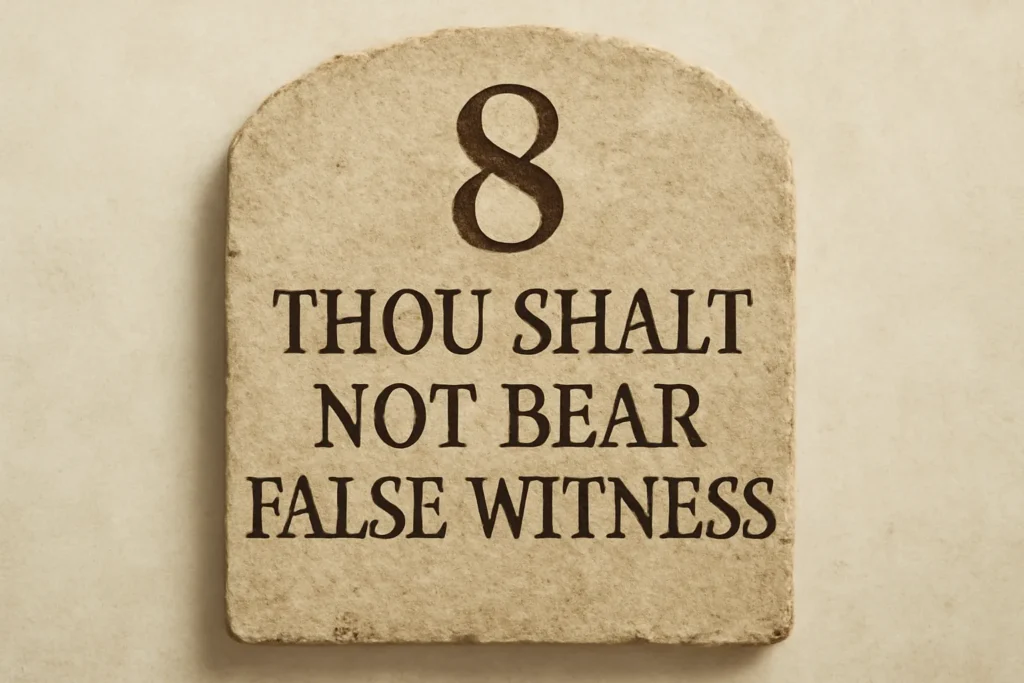
The topic the 8th commandment has a long and sometimes confusing history in Christian traditions. Depending on how a denomination numbers the Decalogue, the eighth commandment can refer to different prohibitions. In many Protestant and Orthodox lineages, the eighth commandment is phrased as “You shall not steal”, a direct injunction against theft and deceit in matters of property. In Catholic tradition, however, the eighth commandment is typically associated with “You shall not bear false witness against your neighbor”, a strong call to honesty, integrity, and truth-telling. This article uses the term 8th commandment bible as a gateway to explore both forms, their meaning, history, and relevance today, and it explains how this moral guidance shapes personal ethics, social life, and public policy in the modern world.
Meaning and core principles of the 8th commandment
To understand the eighth commandment, it helps to start with its two principal articulations that appear in the Bible’s Decalogue across traditions. Although numbering differs, the underlying ethical concerns are closely related: property rights and truthfulness, or more broadly, how people relate to one another in a just and trustworthy society.
Two complementary expressions
You shall not steal — the prohibition against taking someone else’s property or resources without permission, with or without deceit. This form emphasizes respect for ownership, labor, and legitimate exchange in economic life.
You shall not bear false witness against your neighbor — the prohibition against lying, misrepresenting, or deceiving others in ways that harm reputation, justice, or social trust. This form emphasizes truth-telling, integrity, and reliability in personal and public life.
Historical context and the development of the 8th commandment
The Decalogue in ancient tradition
The Ten Commandments emerged in ancient Near Eastern and Israelite contexts as a foundational moral code. In Jewish, Greek, and early Christian manuscripts, the commandments were transmitted in slightly different orders and wordings. The eighth commandment appears within a cluster of prohibitions that address moral conduct, economic justice, and interpersonal trust.
In many Protestant traditions, the sequence is arranged so that the eighth commandment is typically “You shall not steal” (Exodus 20:15; often labeled as the 7th or 8th depending on the tradition). This has made the property rights aspect a prominent feature of the eighth commandment in popular culture.
In Catholic tradition, the eight commandment tends to be read as “You shall not bear false witness against your neighbor” (Exodus 20:16, Catholic numbering), highlighting the spiritual and communal dangers of deceit and defamation.
Among various Orthodox and agnostic readers, the same pair of prohibitions is understood as two sides of a single ethical coin: honesty in speech and honesty in behavior toward others’ goods and reputation.
Historically, the Decalogue was transmitted through Hebrew scriptures, later translated into Greek as the Septuagint, and then into Latin as the Vulgate before spreading through Western Christianity. As it traveled, religious authorities and scholars debated the exact wording, the scope of the prohibitions, and how they should be applied within evolving legal and social contexts. This is why the 8th commandment is a vivid example of how even small numbering differences can reveal deep shifts in emphasis: a focus on deception vs. a focus on theft, a focus on truth-telling vs. a focus on ownership, or a blend of both depending on the tradition.
Over centuries, the moral intuitions behind the eighth commandment informed customary laws, commercial ethics, and the basic norms of interpersonal behavior. In medieval Christendom, the prohibition against theft contributed to the development of secular laws protecting property, as well as to the concept of restitutive justice—compensating a victim for losses caused by wrongdoing. The prohibition against deceit, in its turn, reinforced the importance of oaths, witness credibility, and the prevention of fraud in courts. In short, the historical arc of the 8th commandment tracks the broad evolution of moral reasoning into social order, economic regulation, and civil society.
Interpretive lenses: how different traditions read the 8th commandment
The propitious ambiguity of naming
Because Christian traditions vary in how they number the commandments, the eighth commandment bible phrase often points to more than one prohibition. Here are two major interpretive lenses:
Prohibition against theft (in many Protestant lineages and some Jewish and historical Christian enumerations): This reading concentrates on property rights, fair compensation, and the prohibition of taking what belongs to another without consent. It is frequently invoked in discussions of shoplifting, burglary, embezzlement, and piracy.
Prohibition against bearing false witness (common in Catholic numbering and many traditional Jewish reads): This reading centers on truth-telling, reliability in testimony, honesty in advertising, and the integrity of public discourse. It is frequently invoked in discussions of perjury, defamation, rumors, and misinformation.
Practically, writers and teachers often emphasize one dimension more than the other depending on the audience and the issue. Yet both dimensions remain profoundly connected: dishonest speech can undermine trust in property exchanges just as property theft undermines social trust. The eighth commandment bible thus serves as a dual beacon for personal virtue and communal justice.
Theological and ethical dimensions of the 8th commandment
Property, ownership, and social justice
The prohibition against theft is often interpreted as a call to respect ownership and the labor that creates value. This means more than merely not stealing; it includes fair compensation, honoring contracts, and avoiding exploitative practices. In many ethical systems, wealth inequality and the temptation to gain at the expense of others invite careful reflection on the moral economy of a community.
Truth-telling, trust, and social capital
The prohibition against bearing false witness is frequently linked to the maintenance of trust as a public good. Truthful speech is essential for just judicial processes, reliable journalism, and honest business dealings. When deception proliferates, the costs are borne by the most vulnerable members of society. The eighth commandment biblical instruction invites adherents to cultivate honesty in speech, guard against false accusations, and pursue integrity in the marketplace of ideas as well as the marketplace of goods.
Legal systems often codify these moral intuitions in statutes against theft, fraud, perjury, and false advertising. The eighth commandment serves as a foundational voice in debates about:
Property rights and restitution for theft or misappropriated goods.
Truth in advertising, consumer protection, and the integrity of the judiciary.
Anti-corruption measures aimed at reducing deceitful practices in government and business.
Ethical guidelines in journalism and social media to combat misinformation.
Social justice and restorative approaches
Many theologians interpret the eighth commandment to support policies that reduce harm caused by poverty and exploitation. The emphasis on rightful ownership and truthful communication can be paired with a robust concern for restorative justice, where offenders are encouraged to repair harm and reintegrate into the community. This approach respects both the dignity of the victim and the possibility of transformation for the offender.
Interpreting in pluralistic societies
In increasingly diverse societies, the eight commandment invites dialogue about what constitutes honesty and fairness across cultural and religious lines. It provides common ground for civic education, corporate governance, and civil discourse, even when people hold different beliefs about the divine. The universal themes of truth-telling and fair dealing can be read as moral anchors in a pluralistic public square.
Is the eighth commandment only about money and goods?
While theft concerns material goods, the eighth commandment also encompasses the ethics of truth-telling, which underpins trust in any economic or social system. Misleading information, false advertising, or false accusations can cause as much harm as taking a physical object. Therefore, the commandment’s scope includes both property rights and honesty in speech.
What about situations of necessity or survival?
In moral discussions, situations of necessity or extreme poverty raise complex questions about what constitutes “stealing” versus protecting life and dignity. The broader ethical tradition often allows for charity, mercy, and consideration of circumstances, while still urging people to pursue just and honest solutions whenever possible.
How does this relate to digital life and information?
In the digital era, theft and deception can take forms like cybercrime, software piracy, or fake news. The eighth commandment rhetoric extends to these domains by challenging individuals and institutions to avoid deceit and to respect others’ digital property and reputation. Honesty online—fact-checking, transparent sourcing, and respectful discourse—becomes a contemporary expression of this ancient moral precept.
Across cultures and faiths, the themes encoded in the eighth commandment resonate with universal concerns about trust, fairness, and human dignity. Even when wording differs, communities can use this commandment as a shared reference point for ethical education, social cohesion, and public accountability. It provides a framework for discussing controversial issues like economic justice, artistic property (copyright), and public truth-telling without assuming a single religious perspective.
In today’s rapidly changing world, the 8th commandment bible continues to offer guidance that is both practical and aspirational. Whether one reads it as a prohibition against theft or as a prohibition against false testimony, the core concern is the same: building a society in which people can trust one another, honor commitments, and pursue justice with integrity. The historical development of the Decalogue shows that ethical norms adapt to new contexts, but the underlying call to live with truth, respect, and responsibility endures. For readers seeking a moral compass in personal life, in business, and in public life, the eighth commandment offers a durable reminder that honesty and justice are the foundations of a healthy community.
In sum, the You shall not steal and You shall not bear false witness against your neighbor formulations—whether encountered as the eighth commandment in Protestant numbering or as a closely related eighth prohibition in Catholic numbering—each articulate a commitment to a common good. By understanding the history, keeping the intent in sight, and applying its guidance to modern challenges, readers can cultivate a society that values both material fairness and moral honesty.







Leave a Reply