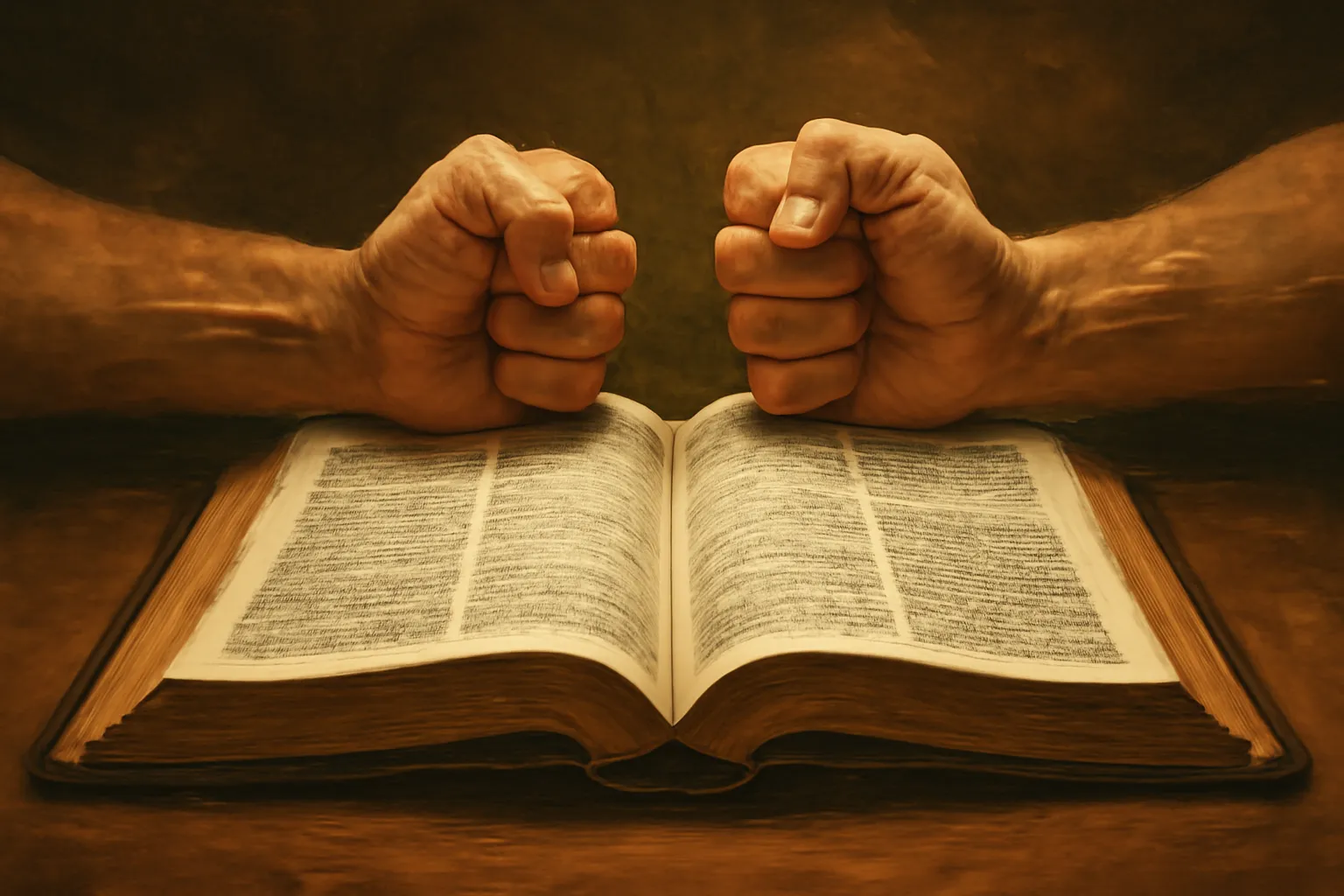
The topic of biblical conflict is not a simple matter of one text disagreeing with another. It is a discussion about
how diverse voices, genres, historical moments, and theological aims shaped what many people read as a single story from a single book. To begin
understanding scriptural conflict, it helps to distinguish between different kinds of tension: textual differences, interpretive
disagreements, and ethical or doctrinal disputes that arise when readers apply ancient writings to modern life.
First, there is the matter of textual transmission. The biblical corpus was produced across centuries and in multiple
languages. Scribal habits, translation choices, and copying errors can yield textual variants that seem to contradict
one another on the surface. In many cases, these variants are relatively minor (such as a single word or a stylistic nuance); in others,
they have sparked lively debate about what the author intended or what the original wording might have been.
Second, there is canonicity—the question of which books belong in the Bible and why. Different religious communities
have proposed different canons, and debates about the authoritative boundaries of Scripture have produced tensions within and
across faith traditions. The process of recognizing, dismissing, or reinterpreting certain texts often reflects historical, cultural, and
pastoral concerns as much as devotional ones.
Third, there are translation and hermeneutics concerns. Translators must choose how to render ancient words, idioms, and
cultural practices for readers who may not share the same historical setting. The act of interpretation—whether one reads a passage
literally, metaphorically, or critically—can lead to a spectrum of readings that are each meaningful in a different way.
Fourth, the Bible spans multiple genres—narrative, poetry, law, prophecy, wisdom literature, letters, apocalyptic writing—
each with its own literary conventions. When readers approach a passage with expectations drawn from a different genre, conflict
can arise if those expectations are not acknowledged.
Finally, historical distance can magnify perceived conflicts. Ancient readers lived in social orders, political realities,
and cultural norms that differ dramatically from those of modern readers. When modern interpreters project contemporary questions onto ancient
texts, apparent contradictions or ethical dissonances may surface.
Historical context and the shaping of the canon
The formation of the biblical canon was a long and contested process. Communities evaluated books based on things like prophetic authority, edifying value, and alignment with shared belief. As a result, certain writings were
recognized as scripture while others were read with caution or set aside. This historical backdrop helps explain
why readers encounter both continuity and tension within the corpus.
Textual variants can occur within manuscripts, later fixed in printed editions but still prompting questions about precise wording.
Editorial redaction may reflect the concerns of a redactor shaping a unified narrative or theological message.
Intertestamental literature, the Apocrypha or Deuterocanonical books in some traditions, testifies to a broader Jewish and early Christian world.
Understanding these origins is not a advocacy of skepticism but an invitation to a more informed reading practice. When we see conflict as a
product of historical development, we can approach the text with humility, curiosity, and a readiness to listen to multiple voices within the
tradition.
Interpretations and disagreements in biblical study
Interpreting Scripture is an activity that blends theology, literary analysis, and historical study.
Different communities and scholars emphasize different tools, which naturally leads to disagreement. Below are major arenas where bible interpretation often diverges.
Hermeneutical approaches
Hermeneutics is the discipline of interpretation. The same text can be read through several complementary lenses:
Literal or face-value reading emphasizes the most straightforward sense, sometimes risking misreading metaphor or genre.
Allegorical or spiritual interpretation seeks deeper or symbolic meanings beneath the surface narrative.
Canonical interpretation prioritizes how a passage fits within the overall arc and themes of Scripture.
Historical-critical method foregrounds the historical context, linguistic studies, and source relationships to illuminate what the text may have meant in its own time.
Literary analysis treats the Bible as literature, examining structure, point of view, imagery, and characterization.
Each approach can yield meaningful insights, but they can also lead to tension when readers converge on different conclusions about a given passage.
Ethical and doctrinal tensions
Ethical questions—such as how to read violence commands, laws about slavery or treatment of neighbors, or
portrayals of women in leadership roles—often spark controversy about how to apply ancient guidance to contemporary life.
Doctrinal debates may center on
Grace and law in the same corpus (how Old Testament law relates to New Testament gospel teachings).
Faith and works (how Paul’s letters on faith relate to James’ emphasis on works).
Millennial expectations or end-time readings that can diverge significantly across traditions.
In many cases, the disagreement is not about whether a text is true but about how a truth is best understood or best lived out
in different contexts. A mature approach to conflict acknowledges that diverse interpretations can coexist, at least in a
broad, polyphonic tradition.
Conflict between testaments and genres
The Bible contains multiple genres—narrative, poetry, law, prophecy, wisdom, epistolary writing, and apocalyptic literature—
each with distinctive expectations. A New Testament quotation may depend on the landscape of the Old Testament, and
readers may need to bridge how a passage is used in a specific literary form with how it is applied in a modern setting.
Additionally, readers often encounter what some call a tension between portrait and prescription:
a narrative painting of events versus a normative command about how readers should live. Recognizing this distinction helps
prevent misreadings that would claim a narrative as a universal rule for every age.
Case studies: notable conflicts and how they are understood
Genesis 1 and Genesis 2: two creation narratives
The two creation accounts in Genesis are a classic example of genre and theology shaping interpretation. Genesis 1 presents a
structured, orderly account of creation culminating in the Sabbath rest, while Genesis 2 offers a more intimate anthropocentric
portrait focusing on humanity and relationships. Some readers worry about contradictions; others view them as complementary
perspectives—one emphasizing divine sovereignty and cosmic order, the other highlighting human relationships and responsibility.
The flood narrative: universal judgment vs local catastrophe
The story of Noah’s flood is sometimes read as a universal judgment on all creation or as a narrative framed within a particular
region or community. Scholarly work on ancient Near Eastern flood myths helps situate the Genesis account alongside
other ancient texts, suggesting that the biblical story is both polemical and theological—asserting monotheism, human sin, and
divine mercy in a specific historical and literary frame.
Commands of total war or destruction in portions of the Old Testament raise difficult questions for readers who advocate peace and
justice. Interpreters have offered a range of responses, including:
Historical context: recognizing ancient warfare norms of the time.
Literary framing: understanding how these passages function within the narrative’s arc.
Theological development: seeing how later biblical writers reinterpret earlier violence in light of progressive revelation.
The letters of Paul and the Epistle of James are frequently read as addressing similar issues from different angles.
The apparent tension between Paul’s emphasis on faith as trust in Christ and James’ emphasis on living
out one’s faith through deeds has sparked centuries of dialogue about how salvation, discipleship, and community
ethics relate to one another.
Gospels: harmonization and the Synoptic Problem
The four Gospels share a substantial amount of material but also contain differences in phrasing, order, and emphasis.
Scholars study the synoptic problem to understand sources (such as a hypothetical Q source) and the ways
each Gospel writer tailors material for particular communities.
Across these case studies, readers are invited to move from a posture of conflict to one of careful comparative reading,
respectful dialogue, and scholarly curiosity.
How to resolve biblical conflict: practical paths forward
Resolving bible conflict—or, more precisely, managing and learning from it—requires a disciplined approach that respects
both tradition and inquiry. The goal is not to erase disagreement but to reach a more coherent and constructive understanding of
Scripture’s message and its application.
Adopt a structured hermeneutic
A robust hermeneutical framework helps readers move beyond surface tension to deeper coherence. Useful steps include:
Identify the genre of the passage (narrative, poetry, law, prophecy, epistle, apocalyptic, wisdom).
Examine historical context and the author’s likely purpose.
Consider the cultural setting and how first-century readers would have interpreted the text.
Note how the passage fits within the contractual arc of the Bible—its covenantal context and its relation to the
overarching themes of sin, redemption, and justice.
Compare multiple translations to capture nuances, then consult reliable commentaries and scholarly resources.
Engage with canonical and noncanonical perspectives
Recognizing the difference between canonical authority and broader religious literature can prevent misreadings.
Some traditions affirm a fixed canon, while others engage a wider field of texts. A mature approach involves understanding the function
and limits of each book within its own community, then exploring how later readers have wrestled with its meaning.
Balance fidelity with practicality
While preserving the integrity of the text, readers should also consider how Scripture speaks today. This means distinguishing
what the text prescribes for all times from what it illustrates within a particular cultural moment. Such discernment helps
in ethical reflection and in the pastoral use of Scripture.
Practice humility and dialogue
A healthy engagement with biblical conflict invites humility—recognizing the limits of our own knowledge and the existences of
legitimate scholarly and theological differences. Dialogue with others—across traditions, confessional lines, and
scholarly disciplines—frequently yields richer understandings than solitary inquiry.
Readers can adopt concrete practices to manage and resolve conflicts constructively:
Keep a running list of passages that seem in tension and annotate the questions they raise.
Cross-check multiple translations and consult lexical resources for key terms.
Read surrounding verses to avoid isolated readings; consider macro-structures such as chapters, books, and canons.
Utilize scholarly annotations, introductions, and background studies to illuminate historical context.
Seek guidance from trusted mentors, pastors, or academic resources when encountering difficult passages.
Practical guidance for readers confronting difficult biblical passages
When you encounter passages that seem troubling or contradictory, these practical steps can help you navigate with clarity and care:
Clarify the question: Are you asking about historical reliability, literary coherence, ethical application, or doctrinal
coherence? Stating the question clearly helps focus the investigation.
Test the context: Look at the verses around the passage, the genre, the historical moment, and the audience addressed.
Compare translations: See how different Bible translations render key words and how that affects interpretation.
Consult reputable resources: Commentaries, scholarly articles, and survey works provide interpretive options rooted in research.
Respect differing conclusions: Accept that reasonable, well-informed readers may arrive at different but credible conclusions.
Apply ethically: Distinguish between what the text says about ancient life and how it may inform contemporary ethics,
ensuring that application is consistent with broader biblical principles such as justice, mercy, and love.
An important practice is to approach the text with a spirit of curiosity and humility, rather than a posture
of final authority. Scripture invites ongoing engagement, conversation, and growth of understanding over time.
Resources for ongoing study and reflection
Readers who want to deepen their engagement with biblical conflict often turn to a combination of study aids, academic
resources, and community-based discussion. The following categories can be helpful as you explore these topics:
Introductions to the Bible that outline structure, genres, and themes across the canon.
Commentaries on individual books, offering historical background, language notes, and interpretive options.
Phrase-by-phrase lexical aids for original languages (Hebrew and Greek) to deepen word-level understanding.
Historical-critical studies that examine sources, redaction, and ancient contexts.
Comparative religion writings that illuminate how other ancient traditions address similar questions.
Engaging with these resources through community study—whether in a church study group, a campus club, or an online
forum—can provide fresh perspectives and help readers grow in their ability to handle conflict constructively.
Ethical and pastoral dimensions
Beyond academic inquiry, the resolution of biblical conflict often has profound pastoral implications. Communities
seek guidance on how to teach, preach, and live out the text in ways that honor both the integrity of Scripture and the dignity
of diverse readers. This is especially important when dealing with sensitive issues such as justice, human dignity, gender roles, and peaceful living.
In sum, the Bible contains a rich tapestry of voices, moments, and ideas. The presence of conflict within Scripture is not a sign
of failure but a feature of a text that has engaged generations in lifelong exploration. The goal for readers today is not to erase
disagreement but to cultivate a disciplined and compassionate method for understanding and applying the truths that Scripture offers.
Bible About Learning: A Foundation for Lifelong Growth Learning is not merely an academic pursuit in the bible about learning genre; it is a spiritual discipline that shapes character, informs decisions, and sustains resilience across a lifetime. When we speak of Scripture-inspired growth, we are inviting a way of studying and living that blends curiosity…
Bible Library: The Ultimate Guide to Bible Study Resources, Versions, and Tools is more than just a catalog of books. It is a practical roadmap for readers who want to explore the depth and breadth of Scripture. Whether you are a student, a pastor, a layperson, or a curious lifelong learner, building and using a…
Introducción: ¿Quién fue Moisés y por qué importa? Moisés es una de las figuras centrales de la Biblia y, a la vez, una de las más complejas en la tradición judeocristiana. Considerado como el liberador del pueblo de Israel, el mediador de la Alianza y el legislador de la Ley, su vida atraviesa episodios de…
Bible Story About Patience: Timeless Biblical Lessons on Waiting with Faith Across the pages of Scripture, patience is not merely a passive waiting but an active, living trust in God’s promises. Patience in the Bible emerges as a dynamic virtue that grows through trials, delays, and divine hard choices. This article explores a broad tapestry…
25 Engaging Bible Discussion Topics for Small Groups Welcome to a curated set of bible discussion ideas designed for small groups. Whether your group is meeting weekly or biweekly, these topics offer practical, Scripture-centered prompts that invite participation, honest questions, and meaningful application. Each topic provides a brief overview, a set of discussion prompts, and…
Bible Secrets Revealed: Discover Hidden Insights From Scripture The Bible often speaks in layers. What appears on the surface is valuable, but beneath the plain text lie hidden insights, enigmatic connections, and patterns that invite careful study. This article explores how to approach those bible secrets—not as a game with coded messages, but as a…