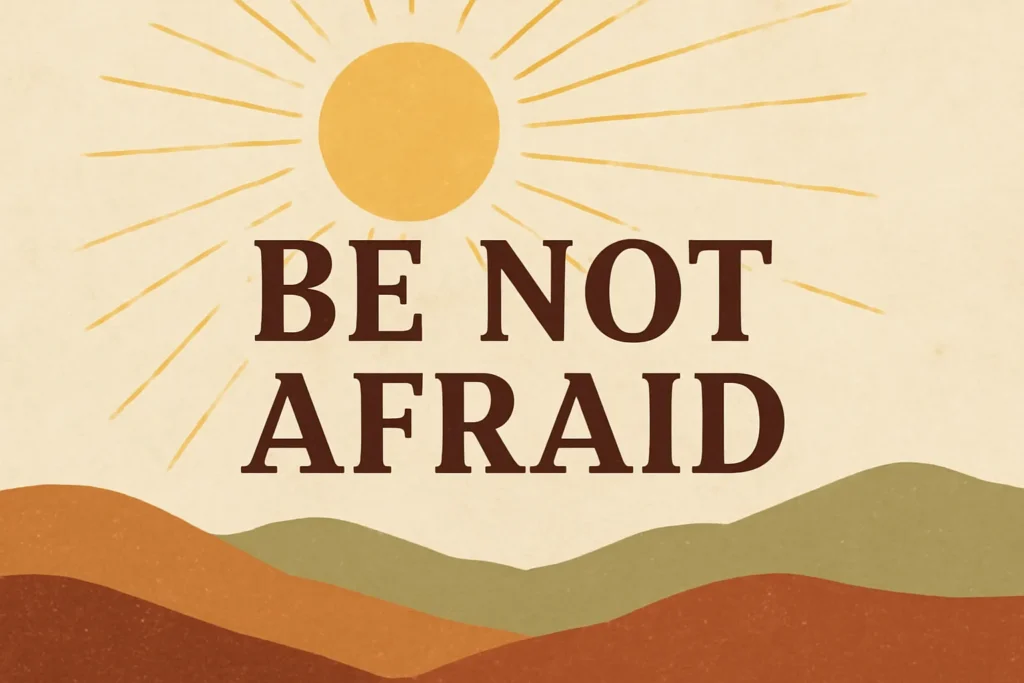
This article gathers seven powerful verses that speak directly to fear and the courage God offers. Each section presents a different scriptural promise, phrased in variations of “be not afraid” or “fear not”, to widen the semantic breadth of what courage looks like in daily life. Whether you are facing a transition, a trial, or an ordinary moment of anxiety, these verses invite you to anchor hope in God’s presence, power, and promises.
Section 1 — Joshua 1:9: Be strong and of a good courage; be not afraid
Have I not commanded thee? Be strong and of a good courage; be not afraid, neither be thou dismayed: for the Lord thy God is with thee whithersoever thou goest. — Joshua 1:9 (KJV)
Context and promise
In a moment of transition and responsibility, God calls Joshua to courage as he steps into leadership after Moses. The command is not only a message to Joshua but to everyone who faces new paths with uncertain outcomes. The words carry a triple emphasis: strength, courage, and presence.
The verse centers on a simple, life-shaping truth: God is with you wherever you go. That divine accompaniment does not erase difficulty, but it redeems fear by reframing it as a signal to lean harder on God, not to retreat.
Reflection and meaning
When we hear “be not afraid” in the Bible, it is often paired with a challenge: step forward, act with integrity, or trust when outcomes seem uncertain. The phrase is not a denial of danger but a courageous commitment to trust in God’s plan even when the path is unclear.
Practical ways to apply this verse
Memorize the verse and recite it aloud at the start of a challenging day.
Identify one upcoming decision or transition and commit to moving forward with prayer and prayerful planning.
Pair action with faith: take a concrete step today, knowing God accompanies you in every mile.
Section 2 — Isaiah 41:10: Fear not; I am with you
Fear thou not; for I am with thee: be not dismayed; for I am thy God: I will strengthen thee; yea, I will help thee; yea, I will uphold thee with the right hand of my righteousness. — Isaiah 41:10 (KJV)
In this passage, God offers a resounding, personal assurance: His presence is the antidote to fear. The repetition of “not fear” and “not be dismayed” reinforces a covenant relationship: God is both near and powerful for those who belong to Him.
Courage is not a solitary feat; it arises from confidence in God’s holding power and unfailing support. Knowing that God is your God who strengthens and helps reorients fear into faith.
Practical ways to apply this verse
Keep a short list of fears and invite God to meet you in them with His strength.
When anxiety rises, pause to acknowledge God’s presence aloud: “You are with me.”
Practice small acts of courage in daily life and attribute success to God’s sustaining grace.
Section 3 — Psalm 27:1: The Lord is my light and my salvation
The Lord is my light and my salvation; whom shall I fear? The Lord is the strength of my life; of whom shall I be afraid? — Psalm 27:1 (KJV)
Context and promise
David’s confidence comes from recognizing God as both illumination and protection. The imagery of light dispelling darkness offers a powerful metaphor for our fears: when God is present as light, fear loses its hold.
Why this verse resonates in times of uncertainty
When life presents fog, danger, or relational strain, the question “whom shall I fear?” shifts from an accusation of fear to a declaration of trust. This is less about dismissing fear and more about affirming God’s supremacy over it.
Practical ways to apply this verse
Spend time in reflection or journaling about what “light” means in your current situation.
Ask God to reveal areas where fear imitates wisdom and invite His light to illuminate them.
Use this verse as a daily affirmation in the morning: declare that God is your light, salvation, and defense.
Section 4 — Luke 12:32: Fear not, little flock
Fear not, little flock; for it is your Father’s good pleasure to give you the kingdom. — Luke 12:32 (KJV)
Context and promise
Jesus speaks to a circle of followers who often faced material need, social pressure, and spiritual doubt. The gentle address “little flock” underscores care and intimacy, while the promise of the kingdom signals a generous, future-oriented faith.
What this verse invites us to trust
Courage here is rooted in the knowledge that the Father’s intention is to give generous, good gifts—an invitation to relinquish fear and receive with gratitude the Father’s provision and purpose.
Practical ways to apply this verse
Create a small trust list: write down worries and replace them with a reminder of God’s gifts and future promise.
Practice gratitude as a daily rhythm, acknowledging the Father’s good pleasure in giving you the kingdom.
Let community support be a channel of courage—share burdens with trusted friends or mentors.
Section 5 — 2 Timothy 1:7: God hath not given us the spirit of fear
For God hath not given us the spirit of fear; but of power, and of love, and of a sound mind. — 2 Timothy 1:7 (KJV)
Context and promise
Paul writes to Timothy to encourage him to persevere in ministry despite intimidation, armed with a divine spirit of power, love, and self-discipline. This is not a denial of danger but a proclamation that fear does not define a follower of Christ.
Power gives we the energy to act rightly; love anchors our choices in others’ good; sound mind protects our thoughts from spiraling into panic. Courage is a posture that blends strength with care and wise judgment.
Practical ways to apply this verse
Identify a situation where fear tempts you to retreat—name it and declare God’s gifts to you in that moment.
Practice a small act of power-directed courage today, perhaps sharing a honest concern with a trusted friend or stepping into a difficult conversation with grace.
Develop a routine that fosters a sound mind: prayer, meditation on Scripture, and practical planning.
Section 6 — Psalm 23:4: I will fear no evil
Yea, though I walk through the valley of the shadow of death, I will fear no evil: for thou art with me; thy rod and thy staff they comfort me. — Psalm 23:4 (KJV)
Context and promise
The imagery of the valley of the shadow of death is poignant—danger, darkness, and peril are not fictional; yet the psalmist refuses fear because of God’s presence and shepherd-care. Courage here is not a denial of danger but a confident trust that God’s guidance brings comfort.
The power of God’s presence
God’s presence is the enduring source of security. The shepherd’s staff and rod symbolize guidance and protection, reminding us that even in dark places, we are watched, led, and sustained.
Practical ways to apply this verse
In moments of fear, imagine yourself beside the shepherd and invite his guidance into your choices.
Practice breath prayers: “Lord, you are with me” as fear arises.
Keep a small reminder of comfort (like a Scripture card or a photo) in your pocket or on your desk to recall God’s steady presence.
Section 7 — Isaiah 43:1–3: Fear not, for I have redeemed thee
But now thus saith the Lord that created thee, O Jacob, and he that formed thee, O Israel, Fear not: for I have redeemed thee, I have called thee by thy name; thou art mine. When thou passest through the waters, I will be with thee; and through the rivers, they shall not overflow thee: when thou walkest through the fire, thou shalt not be burned; neither shall the flame kindle upon thee. — Isaiah 43:1–2 (KJV)
Context and promise
In these verses, God speaks to people who carry a deep sense of identity and vocation. The command “Fear not” is paired with a robust declaration of redemption, naming, protection, and presence through trials.
Courage here is rooted in being known by God, called by name, and protected through waters, rivers, and fire. The imagery reminds us that life’s storms cannot redefine our worth or separate us from God’s care.
Write your name into the promise: “I am redeemed, I am called by name; I am God’s.” Say this aloud to counter fear.
When confronted with trials, recall the “through the waters, through the fire” assurance and invite God’s presence to guide you through safely.
Develop a gratitude habit for God’s faithfulness in past difficulties, letting that memory bolster current courage.
Each of these seven scriptures offers a distinct facet of courage rooted in God’s character: His command to be brave, His constant presence, His protective care, and His promises for the future. The variations of “be not afraid” and “fear not” reflect a holistic approach to fear—passages that invite heart, mind, and will to align with faith.
Ways to cultivate ongoing courage in daily life
Daily quiet time: begin with a short devotional focused on one of the seven verses, letting its truth sink into your heart.
Community support: share fears with a trusted friend or mentor and invite accountability in taking brave, God-led steps.
Prayer practices: use a short, repeated prayer like, “Lord, be with me; give me courage; let me act in love.”
Action steps: set small, achievable goals that require faith and trust in God’s presence, and celebrate progress rather than perfection.
In secular life, fear often emerges as a reaction to uncertainty, risk, or change. In biblical storytelling, courage is not the absence of fear but the choice to move forward in faith because God is near. By meditating on these seven verses—Joshua 1:9, Isaiah 41:10, Psalm 27:1, Luke 12:32, 2 Timothy 1:7, Psalm 23:4, and Isaiah 43:1–3—you can cultivate a resilient, biblically grounded courage that remains steady in the storms of life.
If you are navigating a difficult season, consider printing or saving these seven verses as a personal badge of courage. Let God’s presence, His promises, and the truth that you are redeemed and beloved become a daily source of reassurance. May your heart grow bold in the knowledge that you do not walk alone, and may your life reflect a calm, courageous witness to the peace that comes from faith.







Leave a Reply