Free Bible Request Form: An Introduction to Submitting Your Request Online Quickly and Easily
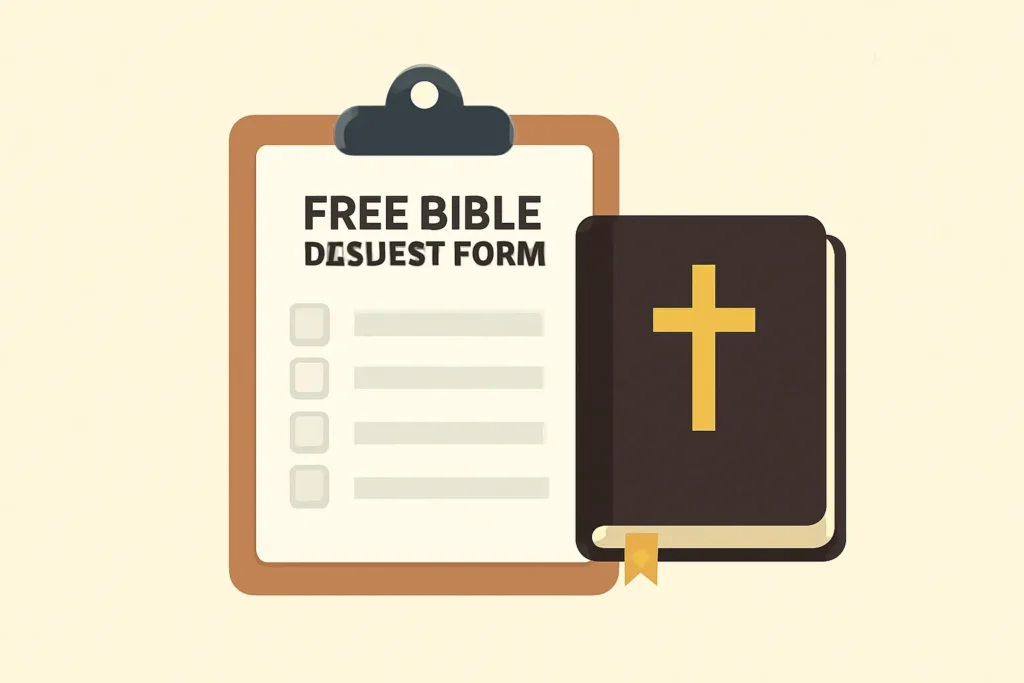
In many communities, churches, ministries, and educational organizations offer free Bible request forms to help people obtain a copy of the Bible or related study materials at no cost. The core idea behind a no-cost Bible request form is simple: a user provides essential information, the organization confirms eligibility if needed, and the requested Bible resources are prepared for shipping or pickup. This article explores free Bible request form usage, best practices for design and implementation, and practical examples that illustrate how to streamline the submission process for visitors while ensuring accuracy, privacy, and efficient fulfillment.
What is a Free Bible Request Form and Why It Matters
A free Bible request form is an online interface that collects minimal but sufficient data to fulfill a Bible request. It is designed to be accessible, user-friendly, and quick to complete. In many contexts, the form is online, no-cost, and streamlined, emphasizing speed and clarity so that individuals can move from request to receipt with minimal friction. A typical form may be labeled as a free Bible order form or a free Bible request submission, but the underlying goal remains the same: remove barriers to access and ensure a reliable process for both the requester and the provider.
Key Benefits of Using a Free Bible Request Form
Accessibility: A digital form makes Bible resources reachable to a broader audience, including people in rural areas or those with mobility limitations.
Efficiency: Collecting standardized data enables faster processing, inventory checks, and fulfillment.
Transparency: Clear instructions, consent language, and status updates help manage expectations.
Record-keeping: A structured submission creates an auditable trail for reporting and analytics.
Automation potential: Integrations with email notifications, shipping labels, or CRM systems reduce manual work.
Common Scenarios for a Free Bible Request Form
Organizations deploy free Bible request forms in several scenarios, such as:
Outreach programs that distribute Bibles to new believers or students.
Church libraries offering copies to members and visitors.
Educational ministries providing Bibles in multiple languages or versions for study purposes.
Scholarship or charity initiatives that supply Bibles to underserved communities.
What Information Should a Free Bible Request Form Collect?
To fulfill a request accurately while protecting privacy, a free Bible request form tends to gather a focused set of fields. The data can be categorized into several groups:
Personal and contact details
Full name
Email address (for confirmation and updates)
Phone number (optional, for delivery coordination)
Country and mailing address (for shipping)
Request specifics
Preferred Bible version (e.g., King James Version, New International Version, New Living Translation, etc.)
Language preference (if applicable)
Quantity of Bibles needed
Format preference (print Bible, compact edition, study edition, or digital copy)
Intended recipient group (individual, family, church, school, etc.)
Fulfillment details
Delivery method (mail, in-person pickup, or digital delivery)
Delivery timeframe or deadline (if any)
Special instructions (e.g., large print, hearing-impaired accessibility, gift note)
Consent and policy acknowledgments
Privacy notice acknowledgment
Consent to use data for fulfillment and occasional updates
Agreement to terms and conditions related to free materials
Designing an Effective Free Bible Request Form
Design quality is essential for both user experience and data integrity. A well-crafted form reduces abandonment, improves accuracy, and speeds fulfillment. Consider the following best practices when building a free bible request form or its variations:
Keep it concise: Request only essential data. You can collect additional preferences in later steps if needed.
Logical flow: Group related fields together and use progressive disclosure to reveal advanced options only when appropriate.
Clear labeling: Use plain language labels and placeholders to guide users. Include field-level help where necessary.
Responsive design: Ensure the form functions well on desktops, tablets, and smartphones.
Validation: Use real-time validation for required fields, proper email format, and valid postcodes where applicable.
Accessibility: Label all fields, ensure good color contrast, and support keyboard navigation and screen readers.
Privacy protections: Communicate how data will be used, who will access it, and how long it will be stored.
Security: Use CSRF protection, server-side validation, and HTTPS to protect submitted data.
Localization: If you serve multilingual audiences, provide language options and translations where possible.
Below is a representative example of a straightforward HTML form that captures essential data for a free Bible request. This example focuses on clarity, accessibility, and basic client-side validation. It is suitable for embedding on a church, ministry, or library site as a starting point. You can adapt the fields, wording, and styling to fit your organization’s policies and branding.
Notes on the sample:
The form action should point to a secure endpoint on your server capable of handling submissions securely.
Field validation is shown on the client side via required attributes; server-side validation is still essential.
Consider adding a CAPTCHA or reCAPTCHA for bot protection if you expect high traffic or if spam could be a concern.
Enhancing the Form: Validation, Accessibility, and Usability
Beyond the basics, you should optimize a free Bible request form for both accessibility and reliability. The following are practical steps to improve quality and user satisfaction:
Accessible labels: Ensure every input has a corresponding
Arc of focus: Use logical tab order; set focus to the first field when the page loads and provide clear focus rings for keyboard users.
Progress indicators: If the form is longer, show a progress bar or step indicators to reassure users.
Inline validation: Provide real-time feedback for required fields and format checks without forcing a page reload.
Clear error messages: When fields are invalid, show precise, non-judgmental messages to guide correction.
Descriptive success messages: After submission, confirm what happens next (e.g., “We’ve received your request; you’ll hear from us within 1–2 business days”).
Responsive typography: Use legible font sizes and ample line height for readability on small devices.
Privacy and Security Considerations for a Free Bible Request Form
Privacy is a central concern when collecting personal information. A responsible organization communicates clearly about how data will be used and protected. Consider these guidelines when implementing your Bible request submission system:
Data minimization: Collect only what is strictly necessary to fulfill the request.
Encryption: Use HTTPS to encrypt data in transit; consider encryption at rest for sensitive fields.
Access controls: Limit who can view or export submission data; implement role-based access where appropriate.
Retention policy: Define how long you store data and when it is securely deleted.
Compliance: Align with regional privacy laws (for example, GDPR for the EU, CCPA for California) and provide a privacy notice in the form heading or a linked policy.
Integrations and Workflows: Turning Submissions into Fulfilled Requests
A free Bible request form is most powerful when it connects to your fulfillment workflow. Integrations can help automate steps from confirmation to shipping. Common components include:
Customer relationship management (CRM) or donor databases to store contact details and track communications.
Order management software or in-house fulfillment systems to manage inventory, packaging, and shipping labels.
Automated emails to confirm receipt, provide a tracking number, or request additional information if needed.
Inventory alerts so staff can monitor stock levels of Bibles in different versions and languages.
Analytics to understand demand patterns by geography, language, or Bible version, informing future outreach.
Variations and SEO Perspectives: Different Names for the Same Concept
To reach a broad audience, you might publish and optimize pages using variations of free Bible request form. Consider these related phrases and how they map to user intent:
No-cost Bible request form
Free Bible order form (emphasizing the order process)
Bible material request form (broader scope, including study aids)
Bible distribution request form (focus on distribution programs)
Using these variations in headings, meta descriptions, and body text can help improve discoverability for users who search with different terms. Use semantic variety to maintain readability while strengthening SEO fundamentals.
Best Practices for Hosting a Free Bible Request Form on Your Website
When you embed or link to a free Bible request form, consider the following best practices to maximize usability and trust:
Placement: Position the form on a dedicated page with a clear call to action, or embed it on a resource page where visitors expect to request materials.
Loading speed: Optimize assets and host the form on a content delivery network (CDN) if possible to reduce latency.
Brand alignment: Use your organization’s branding, including colors, fonts, and logos, to build trust and recognition.
Clear eligibility criteria: If you have limitations (e.g., geographic restrictions), state them plainly to prevent frustration.
Print and accessibility options: Provide an alternative method for submission (phone, email) for users who cannot access the form digitally.
Alternative Scenarios: When a Free Bible Request Form Isn’t Enough
While a free Bible request form can be highly effective, some situations require additional channels or steps. Consider these alternate approaches to ensure inclusive access:
Phone-based requests for people who prefer spoken communication or lack internet access.
Printable forms that can be downloaded, filled out offline, and mailed or dropped off at a center.
Walk-in fulfillment for local communities that benefit from direct, in-person assistance.
multilingual support by offering translations or interpreter services to accommodate non-English speakers.
Quality Assurance: Testing and Quality Control for a Free Bible Request Form
Before going live, you should test the form across devices, browsers, and network conditions. Consider the following checks as part of your QA protocol:
Maintenance and Updates for a Free Bible Request Form
Over time, you may need to update the form to reflect changes in Bible versions, languages, or policy. Consider a maintenance plan that includes:
Periodic reviews of field relevance and data collection requirements
Version control for the HTML form to track changes
Regular checks on third-party services (CAPTCHA, analytics, email delivery)
Retraining staff on new processes if fulfillment workflows evolve
Case Studies: Real-World Applications of a Free Bible Request Form
In practice, many ministries and libraries use a free Bible request form to streamline outreach. Here are brief, generalized case studies to illustrate potential outcomes:
Community outreach: A church distributes Bibles to families in need, using the form to collect addresses and preferred versions; fulfillment is tied to a monthly distribution schedule.
Educational partnerships: A Bible college offers study Bibles to students enrolled in a language program; forms route to the campus bookstore for quick pickup.
International programs: A nonprofit organization ships Bibles in multiple languages; the form captures language preferences and shipping restrictions by country.
How to Promote and Encourage Use of a Free Bible Request Form
Promotion helps ensure the form reaches those who can benefit from it. Consider these strategies:
On-site visibility: Place signage at church entrances or library corners with a QR code linking to the form.
Digital channels: Share the form link through newsletters, social media posts, and outreach emails.
Partnerships: Collaborate with community centers, schools, and language groups to spread awareness about the resource.
Accessibility Checklist for Your Free Bible Request Form
Use the following quick checklist to ensure the form remains inclusive and usable by a broad audience:
All fields have associated labels and explicit instructions.
Required fields are clearly marked; optional fields are distinguishable.
The form works with screen readers and keyboard navigation is supported.
There is a visible and accessible error message for invalid input.
The form adapts gracefully to mobile devices and small screens.
Conclusion: The Power of a Free Bible Request Form in Modern Outreach
In the digital era, a well-crafted free Bible request form serves as a practical gateway to spiritual resources, education, and community engagement. By focusing on simplicity, privacy, accessibility, and reliability, organizations can offer a reliable way for individuals to obtain a Bible or related study materials without financial barriers. Whether you call it a free Bible request form, a no-cost Bible order form, or a complimentary Bible request, the underlying objective remains consistent: empower people, support learning, and strengthen outreach through a user-centric, secure, and efficient online process. When implemented thoughtfully, this tool becomes more than a form; it becomes a conduit for connection, study, and spiritual growth across diverse communities.








Leave a Reply